
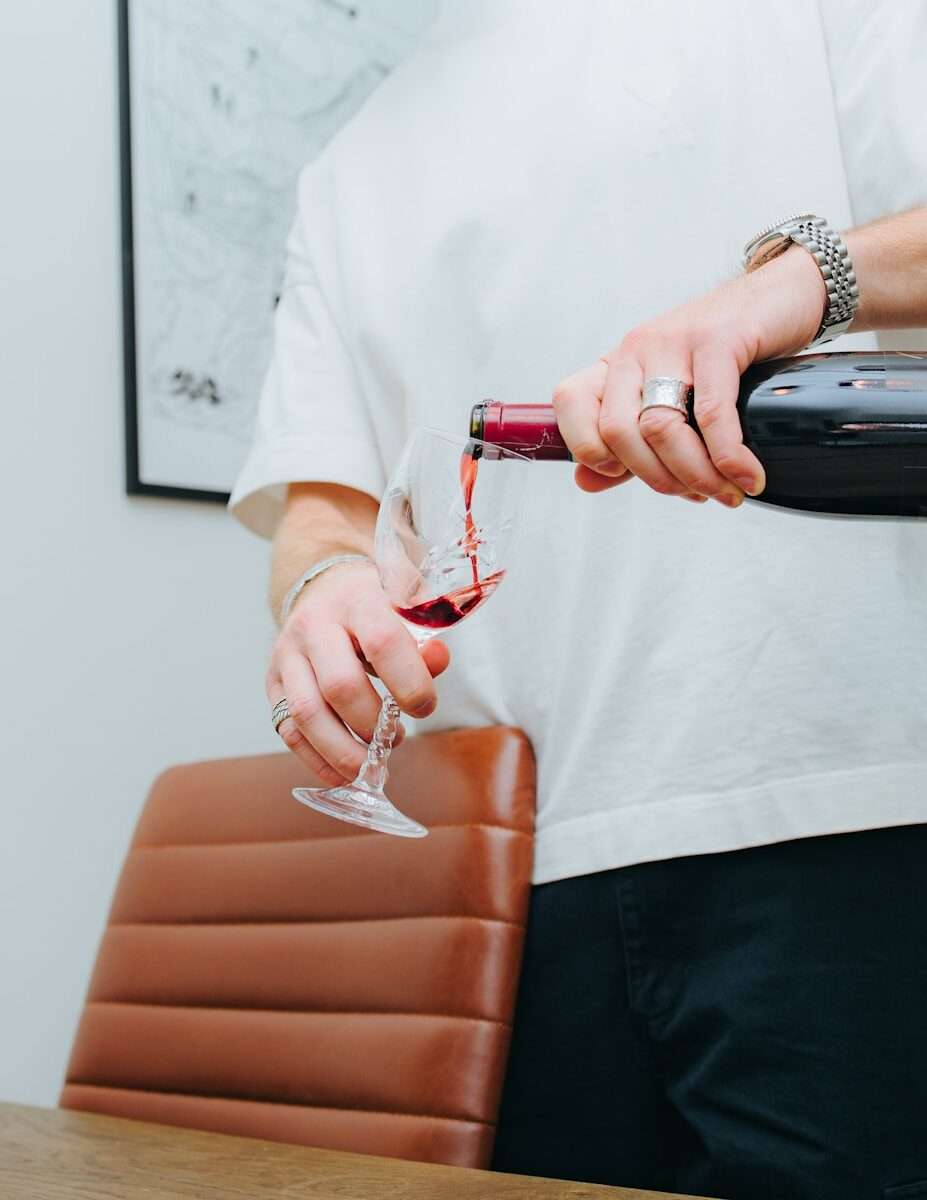
You have a bottle of wine and nothing to open it with. It happens to everyone. Some methods for opening wine without a corkscrew are safe, effective, and worth knowing. Others look impressive in videos and reliably result in broken glass, wine-soaked ceilings, or worse.
Here are the methods that actually work, in order from most to least reliable.
How to Open Wine Without a Corkscrew
Method 1: Push the Cork In (Most Reliable)
What you need: A thin, blunt object — a pen, a chopstick, a marker, the back of a spoon handle.
How to do it:
- Remove the foil capsule from the top of the bottle.
- Place the blunt end of your object against the center of the cork.
- Push steadily and firmly downward until the cork drops into the bottle.
- Pour the wine.
Why it works: You’re not fighting the cork — you’re just moving it in the direction it can go. The cork floats in the wine, which is fine for drinking immediately.
Limitations: You can’t reseal the bottle. Some corks that have been in place for years swell and become harder to push through — requires more force or a longer, thinner object.
The wine is drinkable: Yes, immediately. The cork in the wine doesn’t affect the taste if you’re drinking within a few hours.
Method 2: Screw and Pliers (Most Tool-Based Reliable)
What you need: A long wood screw (1.5–2 inches), a screwdriver or drill, and a pair of pliers or a fork.
How to do it:
- Remove the foil.
- Drive the screw into the center of the cork, leaving about an inch of the screw protruding above the cork.
- Grip the screw head firmly with the pliers.
- Pull upward steadily while pressing down on the bottle with your other hand.
Why it works: This mimics exactly what a corkscrew does — threads grip the cork, force extracts it. With a long enough screw and a firm grip, this works on virtually any cork.
Tips: A flathead screwdriver alone can extract the screw by wedging under the screw head and prying. Two forks can work instead of pliers if you hook both under the screw head.
Method 3: Wrap and Tap (The Shoe Method)
What you need: A shoe or other thick-soled item, a wall.
How to do it:
- Remove the foil.
- Place the bottom of the bottle inside the shoe, with the heel of the shoe against the bottle bottom.
- Hold both the bottle and shoe together.
- Tap the heel of the shoe firmly and rhythmically against a wall (or a tree, a concrete surface — something solid but not too hard).
- After several taps, the cork will gradually work its way out. Stop when it’s far enough to remove by hand, or when it’s fully out.
Why it works: The inertia of the wine inside the bottle creates pressure against the cork with each impact. The cork slowly unscrews itself.
Important: Do this on a carpeted wall or against a towel-wrapped surface. Do not do this against tile, brick, or a car. Stop when the cork is halfway out — at that point, pull it by hand. If you let it pop out on its own, the wine inside can spray.
This method fails when: The cork is completely flush with the bottle and won’t catch the impact correctly. Works best on a cork that’s already slightly proud.
Method 4: Knife (Careful, Works Well)
What you need: A sturdy kitchen knife — not a sharp chef’s knife, ideally a butter knife or table knife.
How to do it:
- Remove the foil.
- Insert the blade of the knife into the side of the cork at an angle, about halfway down the cork.
- Work the blade in a circular motion while applying upward pressure.
- Slowly rotate the cork out.
Why it works: The knife acts as a lever. The side insertion gives you grip on the cork material.
Important: This requires patience, not force. Don’t pry aggressively — you risk breaking the cork and pushing fragments into the wine, or worse, losing grip.
Alternative knife method: Insert the knife at a very slight angle into the top of the cork, work it in partially, then twist and pull upward.
Method 5: Serrated Knife (Sabre Method — Only for Sparkling)
What you need: A serrated knife or the back of any knife with a blunt spine. A bottle of Champagne or sparkling wine with a metal cage over the cork.
How to do it:
- Remove the foil and cage.
- Hold the bottle at a 45-degree angle, pointed away from people and breakable objects.
- Run the spine (blunt back) of the knife along the seam of the bottle from the bottom toward the neck, building speed.
- Strike the lip of the bottle at the seam with a clean, confident stroke.
Why it works: The pressure inside a sparkling bottle is significant (around 90 psi). A clean, firm strike at the weakest point (the seam, at the lip) causes the glass to break cleanly along the seam, taking the cork with it.
Important: This is called “sabrage” — a genuine technique with real risk. Point the bottle AWAY from people and glass objects at all times. The glass that breaks at the neck is not dangerous if you do it correctly (it fractures cleanly), but the wine will spray. Practice on cheap sparkling wine, not Champagne.
This method only works on sparkling wine — still wine bottles don’t have enough internal pressure.
Method 6: Wire Hanger
What you need: A wire hanger or thick wire you can shape.
How to do it:
- Unwind the hanger and create a small loop at one end, roughly the size of a corkscrew helix (about 2cm in diameter).
- Push the looped end down alongside the cork, between the cork and the bottle neck.
- Once the loop is past the bottom of the cork, twist and use the loop to grip the cork from below.
- Pull upward with the wire.
Why it works: Instead of gripping the cork from the side (like a traditional corkscrew), you’re leveraging from below. The wire creates a U-shape that catches the bottom of the cork.
This is harder than it sounds. It requires getting the wire past the cork without pushing it in, and then maneuvering it to grip from below. With practice, it works. As a first attempt without any instruction, it’s frustrating.
Methods That Don’t Work Well (Despite Going Viral)
Hitting the bottom of the bottle against a wall directly: Without a shoe or padding to cushion and focus the impact, you’re more likely to break the bottle than move the cork. Don’t do this.
Heating the neck with a lighter or torch: The physics are real (heat expands the air in the neck, pushing the cork up), but in practice this takes a very long time and the glass can crack with uneven heating. Not recommended.
Using a bike pump: This works but requires a specific needle-style pump that punctures the cork. A standard floor pump tip won’t penetrate. If you happen to have the right equipment, it’s effective.
Preventing the Problem
Travel with a wine key. A waiter’s corkscrew folds flat, weighs almost nothing, and costs under $10. There’s no good reason not to have one.
Choose screw-cap wines when packing. Most New Zealand wines, many Australian wines, and a growing number of wines everywhere use screw caps. Quality is not compromised — screw caps actually preserve freshness better than cork for wines drunk young.
Know your bottle type. Sparkling wine has a cork with a cage that you remove by hand, then twist-and-pull. No corkscrew needed. Some modern wine bottles use plastic stoppers that pull out with just pliers or strong fingers.
For more wine fundamentals, see our wine for beginners guide — covering grape varieties, label reading, and pairing basics. For everything about storing wine once you have it open, see how long wine lasts once opened and whether you need a wine fridge.