If you think German wine means sweet, low-alcohol Liebfraumilch, you’re about thirty years behind the conversation. Modern German wine is some of the most exciting, age-worthy, and terroir-expressive wine made anywhere on earth. The Mosel produces Rieslings of extraordinary finesse. The Pfalz turns out rich, powerful reds. The Rheingau makes wines that can outlast Burgundy in a cellar. And yet German wine remains one of the most misunderstood categories in the world — which, frankly, is an opportunity for anyone paying attention.
This guide covers everything you need to know: the key regions, the main grape varieties, how to decode the notoriously complex label system, and which bottles are actually worth your money.
Why German Wine Deserves More of Your Attention
Germany sits at the northernmost edge of viable viticulture in Europe. That cold climate forces vines to work hard, producing grapes with naturally high acidity and intensely concentrated flavors. The result is wines of remarkable precision — often lower in alcohol, higher in freshness, and longer-lived than their southern European counterparts.
German wine also has an extraordinary range. From bone-dry Spätburgunder (Pinot Noir) aged in French oak to luscious Trockenbeerenauslese dessert wines with decades of aging potential, Germany covers more stylistic ground than most wine-producing countries twice its size.
The tragedy is the reputation problem. Cheap, mass-produced exports like Blue Nun and Black Tower gave German wine a saccharine image that quality producers spent decades trying to escape. Today’s German wine scene is a completely different story — but that old image still lingers, which means you can often find world-class bottles at prices that would be unthinkable in Burgundy or Napa.
The Key German Wine Regions
Germany has 13 official wine regions (Anbaugebiete). You don’t need to memorize all of them, but these six are the ones that matter most.
| Region | Best Known For | Style Profile |
|---|---|---|
| Mosel | Riesling | Ethereal, light, slate-driven, high acidity |
| Rheingau | Riesling | Fuller, more structured, classical |
| Pfalz | Riesling, Spätburgunder | Rich, ripe, diverse styles |
| Rheinhessen | Volume production + quality estates | Broad range, some excellent Riesling |
| Baden | Spätburgunder | Germany’s warmest region, fuller reds |
| Nahe | Riesling | Elegant, mineral, underrated |
Mosel
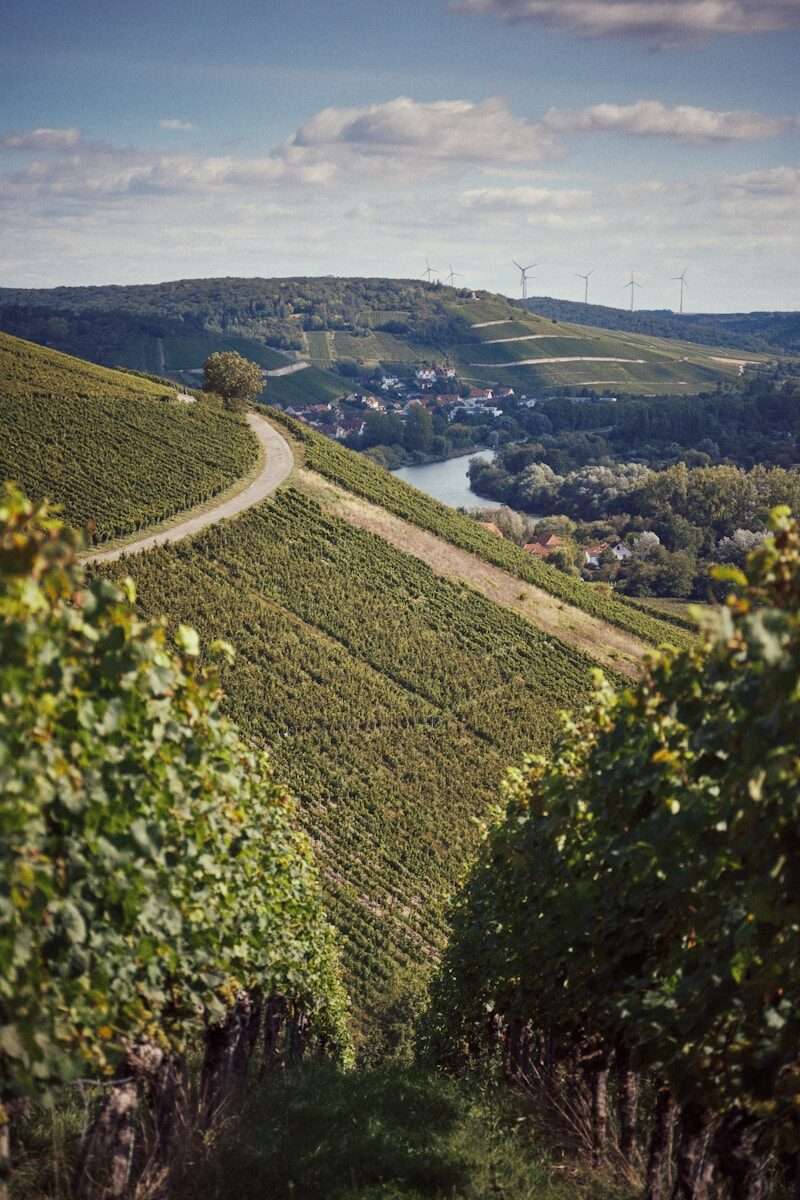
The Mosel is where German wine mythology was born. The river winds through some of Europe’s steepest vineyards — slate slopes so precipitous that all work must be done by hand. Rieslings from the Mosel are unlike anything else: extraordinarily light in body (often 7–9% alcohol), yet intensely flavored, with green apple, lime, white peach, and that distinctive slatey minerality. Producers like Joh. Jos. Prüm, Egon Müller, and Dr. Loosen set a global standard for the variety.
Rheingau
The Rheingau faces south along the Rhine, giving it more sun and warmth than the Mosel. Rheingau Rieslings tend to be fuller-bodied, with more stone fruit and a slightly richer texture. Schloss Johannisberg, one of the most historic estates in all of German wine, sits here. The region also produces excellent Spätburgunder from producers like August Kesseler.
Pfalz
If Mosel is the refined elder, Pfalz is the louder, more exuberant sibling. Germany’s second-largest wine region is warmer, sunnier, and produces both white and red wines with more body and ripeness. Rieslings from the Pfalz can be dry, powerful, and food-friendly. The region is also home to some of Germany’s best Spätburgunder.
Rheinhessen
Germany’s largest wine region by volume, Rheinhessen is a mixed bag — responsible for a lot of industrial production, but also home to some genuinely exciting quality estates working with Riesling, Silvaner, and indigenous varieties. Look for producers in the Wonnegau subzone for serious quality.
German Wine Grapes: Beyond Riesling
Riesling dominates the conversation around German wine, but it’s far from the only grape worth knowing.
Riesling
The undisputed king of German viticulture. Riesling can be made in every style from searingly dry to lusciously sweet, yet always retains that signature high acidity that gives the wine structure and aging potential. Great Riesling from the Mosel or Rheingau can develop for 20, 30, even 50 years in the cellar.
Spätburgunder (Pinot Noir)
Germany’s most important red grape, and increasingly one of the world’s best sources for Pinot Noir outside Burgundy. Baden and the Ahr Valley produce Spätburgunder with real depth and elegance — lighter in color than many New World Pinots, but complex, silky, and age-worthy. Producers like Bernhard Huber (Baden) and Meyer-Näkel (Ahr) are benchmarks.
Silvaner
An underappreciated white grape that thrives in Franken (Franconia). Silvaner makes dry, earthy, food-friendly wines with subtle herb notes and good acidity — the perfect match for regional cuisine. Look for Silvaner in the distinctive Bocksbeutel (squat, rounded flask) that Franken producers use.
Müller-Thurgau
A crossing of Riesling and Madeleine Royale, Müller-Thurgau produces soft, relatively neutral white wines. It’s widely planted for everyday drinking but rarely produces anything memorable. I’d skip it unless you’re after something simple and affordable.
Grauburgunder (Pinot Gris) and Weissburgunder (Pinot Blanc)
Both produce dry, medium-bodied whites that work extremely well at the table. The Pfalz and Baden are their strongholds. These are the grapes to reach for if you want German wine that pairs seamlessly with food but doesn’t have Riesling’s intensity.
Decoding the German Wine Label
The German wine label system has a reputation for being impenetrable. It’s complex, but once you understand the logic, it gives you more information than almost any other wine label in the world.
Quality Levels
German wine quality is officially classified into these levels, from basic to exceptional:
| Quality Level | What It Means |
|---|---|
| Tafelwein | Basic table wine |
| Qualitätswein (QbA) | Quality wine from a specific region |
| Prädikatswein | Premium quality, subdivided by ripeness |
Prädikatswein is where it gets interesting. The six Prädikats, from least ripe to most ripe:
- Kabinett — Light, delicate, can be dry or off-dry
- Spätlese — “Late harvest,” riper fruit, can be dry or medium
- Auslese — Selected bunches, rich and concentrated
- Beerenauslese (BA) — Individually selected berries, usually botrytized, rare
- Eiswein — Made from frozen grapes, intensely sweet
- Trockenbeerenauslese (TBA) — The pinnacle: individually selected shriveled berries, extremely sweet and expensive
Trocken, Halbtrocken, Feinherb
These terms tell you about residual sugar:
- Trocken = Dry
- Halbtrocken = Off-dry (“half dry”)
- Feinherb = A softer off-dry style, used informally by some Mosel producers
One important note: Spätlese or Auslese doesn’t automatically mean sweet. Many top producers make dry (Trocken) versions of Spätlese that are technically high Prädikat but taste completely dry. Always check for the Trocken designation if you want a dry wine.
VDP Classification
The VDP (Verband Deutscher Prädikatsweingüter) is an association of Germany’s top estates. Their classification system, borrowing from Burgundy, is increasingly useful:
- Gutswein — Estate wine
- Ortswein — Village wine
- Erste Lage — Premier Cru equivalent
- Grosse Lage / Grosses Gewächs (GG) — Grand Cru equivalent
Look for the VDP eagle on the label — it’s a reliable signal of quality producers committed to terroir-expressive winemaking.
How to Read a German Wine Label: Practical Examples
Take a label that reads: 2021 Weingut Joh. Jos. Prüm Wehlener Sonnenuhr Riesling Spätlese
Breaking it down:
- 2021 — Vintage
- Weingut Joh. Jos. Prüm — Producer (estate)
- Wehlener — The village (Wehlen)
- Sonnenuhr — The vineyard (“Sundial”)
- Riesling — The grape
- Spätlese — The Prädikat level
This structure (Producer + Village + Vineyard + Grape + Prädikat) is the classic German wine label format, though modern producers sometimes simplify it significantly.
German Wine and Food Pairing
German wine pairs beautifully with a wider range of foods than most people expect.
| Wine Style | Food Pairing |
|---|---|
| Dry Mosel Riesling | Sushi, oysters, white fish, Asian cuisine |
| Off-dry Riesling Spätlese | Spicy Thai or Indian, pork, Asian fusion |
| Auslese | Foie gras, pâté, blue cheese, light desserts |
| Spätburgunder | Duck, venison, mushroom dishes, Pinot-friendly fare |
| Silvaner Trocken | Asparagus, regional German cuisine, river fish |
| TBA/Eiswein | Sip alone or with sharp blue cheese |
The high acidity in Riesling makes it one of the most food-versatile whites in the world. It cuts through fat, balances spice, and refreshes the palate — which is why it’s beloved by sommeliers who work with difficult food pairings.
German Wine Value and Where to Start
You don’t need to spend a fortune to experience great German wine. Here’s a rough guide:
- €10–20 — Entry-level Kabinett or QbA Riesling from reliable producers like Dr. Loosen, Selbach-Oster, or Piesporter
- €25–50 — Excellent Spätlese and Auslese from top estates; single-vineyard GGs from rising producers
- €75+ — GGs from top Mosel estates; Auslese from legendary producers like Egon Müller
I find that German wine delivers exceptional quality-to-price ratio compared to Burgundy or Barolo at the same price points. A €30 GG from the Mosel competes with white wines three times its price from other regions.
German Wine and Team Experiences
For corporate wine events and team tastings, German wine offers something genuinely educational and surprising. Most participants arrive with assumptions — “German wine is sweet” or “I don’t like Riesling” — and leave converted. Walking a group through a vertical tasting (Kabinett → Spätlese → Auslese from the same producer) or a horizontal comparison across regions illustrates how dramatically place and ripeness shape flavor. It’s the kind of sensory discovery that makes wine education memorable and sparks real conversation.
Myrna Elguezabal and the team at The Wine Voyage design exactly these kinds of experiences — structured explorations built around genuine discovery rather than just pouring and talking. If you’re looking for a wine event that gives your team something to talk about, a deep dive into German wine is an unexpectedly compelling choice.
Getting Started: Three Bottles to Try
If you’re new to German wine, these are the three bottles I’d suggest starting with:
- Selbach-Oster Zeltinger Schlossberg Riesling Kabinett — Light, delicate, classic Mosel at a fair price
- Dr. Loosen Blue Slate Riesling Trocken — A dry, approachable entry point that shows what Mosel minerality actually tastes like
- Huber Malterdinger Spätburgunder — Baden Pinot Noir that rivals entry-level Burgundy at a fraction of the price
From there, work your way up the ladder. Find an Auslese from a producer you like and see how the richness changes. Then try a GG from a top estate and understand what Grosses Gewächs actually means in the glass.
If you enjoyed this guide, you’ll also want to read our Riesling Guide, our deep dive into how to taste wine, and our white wine for beginners guide for a broader foundation. For context on where Germany fits globally, check out our wine regions guide and new world vs old world wine comparison.
Further Reading
For deeper exploration of German wine, these authoritative sources are worth your time: Wine Folly’s German Wine Guide covers the key regions and styles with excellent visual maps, and Jancis Robinson on Riesling offers unparalleled depth on Germany’s most important grape.