Running team building activities for large groups is a completely different problem than organizing something for a team of ten. When you’ve got 80, 150, or 300 people in a room, the dynamics change entirely. The activities that create genuine connection at small scale can fall flat or become logistically impossible at scale. And the activities designed for mass participation often sacrifice depth for throughput.
I’ve planned corporate events at both ends of the spectrum, and the thing that separates a memorable large-group experience from a forgettable one is almost never the budget. It’s the structure.
Here’s what I know works — and why.
The Core Challenge with Large Group Team Building
When you scale up, three things break:
Participation equity. In a group of 200, most people are passive observers rather than active participants. If your activity requires one person to be “on” at a time, 199 people are watching. That’s not team building — that’s a show.
Subgroup coherence. People connect with the people next to them, not with the room. Any large-group activity that ignores this is fighting human nature. The goal is to engineer those subgroup moments intentionally, then bring them together.
Logistics overhead. What takes five minutes to set up for 10 people takes 45 minutes for 100. Activities with complex rules, lots of materials, or high coordination requirements create friction that kills momentum.
The best team building activities for large groups solve all three: they create parallel participation across many subgroups, give everyone something to do simultaneously, and run smoothly without a PhD in event logistics.
Formats That Scale Well
Competitive Subgroup Tournaments
Divide your large group into teams of 8–12, run the same activity simultaneously across all teams, then bring the group back together for a final round or reveal.
This is the structure behind almost every large-group team building success I’ve seen. It scales because the energy lives in the subgroups, not in the room. Everyone is engaged in their small team, competing against others, then unified for a shared moment at the end.
Wine and spirits tasting competitions work exceptionally well in this format. Each table of 8–10 people tastes the same flight of wines blind, discusses their guesses, submits their answers — and the competition creates natural conversation and bonding. You can run this for 250 people as easily as 25. The facilitator’s energy goes into the reveal moment rather than trying to manage 250 individuals.
Why it works at scale: Parallel participation means nobody waits. The competitive element creates investment. The reveal creates a shared experience that reunites the subgroups.
Problem-Solving Challenges with Timed Rounds
Escape-room style challenges, puzzle relays, trivia tournaments, and innovation challenges all follow this pattern: give teams a defined problem, a time limit, and something to produce at the end.
The key to making these work at large scale is giving each team an identical task rather than interdependent tasks. Interdependence — where Team A needs Team B’s output before they can proceed — is a logistical nightmare at scale. Independence, with a shared reveal at the end, is clean.
Skill-Based Workshops with Friendly Competition
Workshops where everyone learns something simultaneously — cocktail mixing, cooking, wine blending, painting — work at scale because each person is doing the activity rather than watching. The learning component keeps people engaged even when they’re not directly competing.
Adding a competitive element (best cocktail, most creative blend, most accurate tasting guess) transforms a workshop into a team building activity, because it gives subgroups a shared identity and stakes.
Service Projects
Large-scale community service projects — building care packages, creating school supply kits, assembling bikes for donation — are among the most powerful large-group team building activities for one reason: they give every person a physical role, and the visible output creates collective pride.
These work best when the project is tangible and completable within the event window. Nothing deflates a service project like ending the day with half-assembled materials.
What Doesn’t Work at Large Scale (And Why)
| Activity Type | Problem at Scale |
|---|---|
| Improv/theater exercises | Only works for front participants; audience becomes passive |
| Icebreaker circles | 200-person “two truths and a lie” takes 2+ hours |
| Single-facilitator games | Bottleneck; most people disengaged most of the time |
| Complex interdependent challenges | Coordination overhead scales badly |
| Open networking with no structure | Cliques form; new connections don’t happen |
| Trust falls and physical contact activities | Liability and comfort issues amplify at scale |
Practical Planning Considerations
Room Layout Is Strategy
For team building activities for large groups, the room layout determines whether subgroups can actually function. Round tables of 8–10 are far better than theater-style rows. Cabaret layout (small tables scattered throughout) beats banquet rows. People need to face each other, not the same direction.
If you’re stuck with a theater layout, build breakout moments into the agenda that force people to turn, stand, and interact with their immediate neighbors.
Facilitation Needs to Scale Too
One facilitator for 200 people doesn’t work unless you’ve got very strong audio and a highly structured activity. Plan for subgroup table hosts or co-facilitators — ideally 1 per 15–20 people for interactive activities. These can be trained team members rather than outside hires, which also gives internal ambassadors a leadership moment.
Time Budget Per Head
The more people you have, the longer transitions take. Buffer 20–30% more time than you think you need for: getting seated, distributing materials, answering confused questions, and debrief discussions. A 60-minute activity for 20 people becomes a 90-minute activity for 150 people if you don’t plan for it.
Pre-Event Communication Matters More
At small scale, you can explain rules as you go. At large scale, confusion multiplies — if 10% of your 200 people are confused at any given moment, that’s 20 confused people generating friction. Send clear pre-event instructions, post activity rules visually throughout the room, and do a clean 3-minute demo before starting.
The Best Large-Group Team Building I’ve Seen
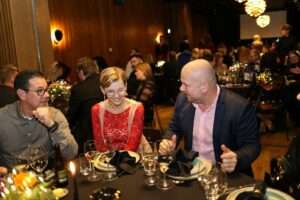
The most successful large-group event I’ve ever been part of was a Blind Wine Tasting Competition for a technology company’s annual sales kickoff — about 180 people. Here’s what made it work:
- Parallel structure: All 20 tables of 9 tasted the same 6 wines simultaneously. Nobody waited for anyone else.
- Built-in conversation: The “what do you think this is?” discussion was organic and natural. Within 5 minutes of sitting down, people who’d never met were debating whether the red was Pinot Noir or Gamay.
- Competitive energy: Each table submitted guesses as a team, so the team identity formed quickly.
- A memorable reveal: Finding out your table got 4 out of 6 right — and that the $15 bottle fooled everyone — is a shared moment that people talk about at the next event.
That’s the template. Whatever the activity, build for parallel participation, natural conversation triggers, team identity, and a shared reveal moment.
The Wine Voyage designs and facilitates exactly this kind of experience for corporate groups of all sizes. Our Blind Tasting Competition has run successfully for groups from 20 to 300+. We handle all logistics — wine sourcing, materials, scoring, facilitation — so your planning effort stays manageable even as headcount grows. We’ve worked with companies like GoFundMe and the Carter Center on large-format events, and the feedback is consistent: people are still talking about it months later.
If you’re exploring options for a large group, our Perfect Blend Competition is another format that scales beautifully — teams blend their own wine from components, then everyone tastes and votes. It’s interactive, educational, and generates a lot of laughter.
Matching Activity to Group Composition
Not all large groups are the same. The right activity depends on:
Group familiarity: New hires or cross-functional groups with lots of strangers need more structured icebreaking built into the activity. Existing teams who know each other can handle more open-ended challenges.
Physical mobility: If your group includes people with mobility limitations, avoid activities that require standing for extended periods, physical challenges, or rapid movement through space. Wine and spirits tastings, trivia, and seated workshops are naturally inclusive.
Cultural diversity: For international teams, avoid activities that rely heavily on cultural references, humor, or language nuance. Universal activities — tasting, creating, solving visual puzzles — work across cultural backgrounds.
Competitive tolerance: Some groups love competition; others find it stressful. Read your audience. For anxiety-prone or conflict-sensitive groups, design for collaboration toward a shared goal rather than head-to-head competition.
Making It Stick After the Event
Team building activities for large groups are investments — the ROI shows up in how much the experience carries into day-to-day work. You can increase that return by:
- Creating a recap: A short photo summary or results announcement sent the next day extends the shared experience.
- Referencing it: Managers who bring up the event in subsequent team meetings — “remember when Sarah’s table was the only one to identify the Riesling?” — reinforce the connection.
- Building on it: If you run an annual event, a recurring format creates continuity. People come in with anticipation rather than skepticism.
The event is the seed. What you do afterward determines whether it grows.
For more on structuring corporate events around tasting experiences, see our wine tasting team building overview and the wine blending competition guide. If you’re earlier in the planning process, the how to plan a team building event guide covers the full framework from objective-setting to vendor selection.
Further Reading
The Harvard Business Review’s research on team cohesion offers context on why shared experiences matter for organizational performance. SHRM’s employee relations resources are a practical reference for HR professionals building large-scale engagement programs.