
Sauvignon Blanc is the most immediately recognisable white wine in the world.
It has a flavour profile unlike any other grape — intensely aromatic, high in acidity, and dry. Once you’ve identified it, you can usually spot it blind. That distinctiveness is exactly what makes it so popular: it’s a white wine with a clear personality.
But “Sauvignon Blanc” covers a wide range. The style produced in New Zealand’s Marlborough is nothing like the style produced in France’s Loire Valley — and both are a long way from what comes out of Bordeaux or California. Understanding those differences is the key to getting the most out of the grape.
What Sauvignon Blanc Tastes Like
Sauvignon Blanc’s flavour profile is built on three pillars: high acidity, aromatic intensity, and herbaceous or citrus-driven fruit.
Citrus — grapefruit, lime, and lemon are the primary notes in cool-climate Sauvignon Blanc. The grapefruit note is particularly distinctive.
Green and herbaceous — cut grass, green pepper, nettles, and fresh herbs. This is most pronounced in cooler vintages and cooler climates. In some bottles it’s subtle; in others (particularly Loire) it’s front and centre.
Tropical fruit — passion fruit, guava, and mango appear in warmer-climate versions, especially Marlborough Sauvignon Blanc. The riper the grapes, the more tropical the fruit profile shifts.
Gooseberry — one of Sauvignon Blanc’s signatures, particularly in New Zealand. Tart and distinctive.
Flint and smoke — top Sancerre and Pouilly-Fumé develop a flinty, smoky mineral quality that’s almost impossible to find in other whites. This is driven by the terroir rather than the grape itself.
High acidity — the most consistent feature. Sauvignon Blanc always has high, refreshing acidity. This makes it one of the best food-pairing whites available.
Dry — virtually all Sauvignon Blanc is bone dry. The fruitiness can make it seem slightly sweet to inexperienced tasters, but there is almost no residual sugar.
Where Sauvignon Blanc Comes From
Loire Valley, France (Sancerre, Pouilly-Fumé)
The Loire is where Sauvignon Blanc shows its most complex, terroir-driven character. The two benchmark appellations are neighbouring communes on the eastern Loire.
Sancerre — on the left bank of the Loire. Flint and chalk soils, steep hillsides. Sancerre Sauvignon Blanc is lean, mineral, and saline, with citrus rather than tropical fruit. At its best, it has a precision and length that’s hard to find elsewhere. It also ages: top Sancerre at 5–8 years develops texture and complexity that most other Sauvignon Blanc can’t reach.
Pouilly-Fumé — across the river from Sancerre, on limestone and flint. The “Fumé” (smoke) refers to the gunflint mineral character that develops with age. Stylistically similar to Sancerre but often slightly fuller in body.
Other notable Loire Sauvignon Blanc appellations: Quincy, Reuilly, Menetou-Salon — less famous, often better value.
Key producers: Henri Bourgeois, Didier Dagueneau, Pascal Jolivet, Domaine Vacheron, François Cotat.
New Zealand (Marlborough)
Marlborough Sauvignon Blanc is the style most people know. It’s a recent phenomenon: the first commercial Marlborough Sauvignon Blanc was released in the early 1980s, and within two decades it had become one of the most successful wine exports in the world.
The style is immediately recognisable: intensely aromatic, with passion fruit, gooseberry, and tropical fruit driving the nose, backed by cut grass and grapefruit. High acidity, full flavour, clean finish.
Marlborough’s combination of bright sunshine, cool nights, and free-draining alluvial soils produces grapes with intense flavour development. The style is designed to be drunk young — most Marlborough Sauvignon Blanc is best within 2–3 years of vintage.
Key producers: Cloudy Bay (the original benchmark), Kim Crawford, Greywacke, Dog Point, Whitehaven, Seresin.
Wairau Valley vs. Awatere Valley: Wairau produces rounder, more tropical Sauvignon Blanc; Awatere (cooler, higher) produces more herbaceous, linear styles. Single-valley wines from serious producers are worth seeking out.
Bordeaux, France
Sauvignon Blanc is one of the permitted grapes in white Bordeaux, often blended with Sémillon. This is a completely different wine from either Loire or Marlborough: fuller-bodied, sometimes oak-aged, and built for aging. Dry white Pessac-Léognan from producers like Château Haut-Brion Blanc or Domaine de Chevalier is some of the most complex white wine made anywhere — and practically unknown outside Bordeaux collectors.
California
California Sauvignon Blanc tends toward riper, more tropical and melon-driven flavours, often with less of the herbaceous character. Some California producers oak-age their Sauvignon Blanc under the name “Fumé Blanc” — a style pioneered by Robert Mondavi in the 1970s. Dry Creek Valley in Sonoma produces some of the most serious California Sauvignon Blanc.
South Africa
South African Sauvignon Blanc, particularly from Constantia and Elgin, occupies a midpoint between Loire and New Zealand — the fruit is tropical but the mineral backbone and acidity keep it closer to Loire in style. Worth exploring as an alternative to both.
Austria and Northern Italy
Austrian Sauvignon Blanc from Styria (Steiermark) is one of the best-kept secrets in wine: intensely aromatic, high-acid, mineral, and completely its own style. Alsatian influence with Austrian precision. Northern Italian Sauvignon Blanc from Alto Adige is similarly distinctive and food-versatile.
Sauvignon Blanc Food Pairing
Sauvignon Blanc’s high acidity and dry, aromatic character make it one of the most food-versatile whites available.
Goat’s cheese — the classic pairing. The acidity of Sauvignon Blanc cuts through the creaminess of goat’s cheese; the herbaceous notes echo the grassiness of the cheese. Loire Sauvignon Blanc with a fresh chèvre is one of the great wine pairings.
Seafood and shellfish — Sauvignon Blanc is the default white for oysters, clams, prawns, and crab. The mineral quality of Sancerre with oysters is a pairing of genuine elegance.
White fish — grilled sea bass, sole, halibut, and other white fish. The acidity lifts the fish and the citrus notes complement it.
Salads with vinaigrette — Sauvignon Blanc is one of the few wines that works with dressed salads. The wine’s own acidity matches the dressing rather than clashing with it.
Asparagus — Sauvignon Blanc is the go-to pairing for asparagus, which kills most other wines. The herbaceous notes in the wine match the vegetable.
Thai and Vietnamese food — the tropical fruit and high acidity in Marlborough Sauvignon Blanc handles the citrus, herbs, and mild spice of Southeast Asian cuisine well.
Green vegetables generally — courgette, peas, green beans, herbs. The herbaceous quality of the wine echoes the food.
What to avoid: Rich cream sauces (the acidity clashes), heavily oaked dishes (the oak overwhelms the delicate fruit), and fatty red meats.
Sauvignon Blanc vs. Chardonnay
These are the two dominant white grapes in the market, and they’re near opposites in style:
| Sauvignon Blanc | Chardonnay | |
|---|---|---|
| Acidity | High | Medium to high |
| Oak | Rarely oaked | Often oaked |
| Body | Light to medium | Medium to full |
| Flavour | Herbaceous, citrus, tropical | Stone fruit, cream, vanilla, toast |
| Best temperature | 45–50°F | 48–55°F |
| Food match | Light fish, salads, goat’s cheese | Rich fish, chicken, creamy dishes |
| Age potential | Mostly young | Can age significantly |
If you find most Chardonnay too heavy or oaky, Sauvignon Blanc is the natural alternative. If you find Sauvignon Blanc too sharp or herbaceous, try an unoaked Chardonnay.
How to Serve Sauvignon Blanc
Temperature: 45–50°F (7–10°C). Cooler than most whites. Over-warming Sauvignon Blanc flattens its aromatics — if it smells less distinctive than expected, it’s probably too warm.
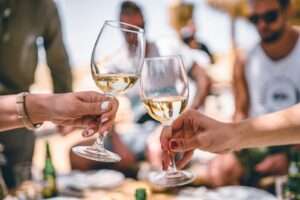
Glass: A standard white wine glass or a smaller tulip-shaped glass. A large Burgundy bowl is unnecessary and dissipates the aromatics.
Decanting: No decanting needed. Pour straight from the fridge.
Age: Drink most Sauvignon Blanc young — within 1–3 years of vintage. Exceptions: top Sancerre, Pouilly-Fumé, Pessac-Léognan, and Bordeaux blends can age 5–10+ years and develop significant complexity.
Sauvignon Blanc Price Guide
Under $15: Reliable everyday Sauvignon Blanc from New Zealand (Kim Crawford, Brancott), South Africa (Ken Forrester), or southern France. Clean, fruit-forward, straightforward.
$15–30: Quality Marlborough single-estate wines, entry-level Sancerre, South African Constantia. Real character begins here.
$30–60: Top Sancerre and Pouilly-Fumé producers, Dog Point, Greywacke Single Vineyard. Complexity and aging potential arrive.
$60+: Didier Dagueneau (the benchmark for Loire Sauvignon Blanc), Henri Bourgeois top cuvées, serious Pessac-Léognan. Some of the finest white wine made anywhere.
For comparison with other aromatic whites, see the Riesling guide and Grüner Veltliner guide. For food pairing principles: wine pairing guide. For how it fits among lighter whites: light white wines.
Further Reading
For producer profiles and vintage assessments on Sancerre and Pouilly-Fumé, Jancis Robinson’s Loire Valley coverage is the most thorough reference available. For New Zealand Sauvignon Blanc context and producer ratings, Wines of New Zealand’s Sauvignon Blanc section covers Marlborough in depth with style guides and producer profiles.