Champagne is the most famous wine in the world — and also one of the most misunderstood. People reach for it on New Year’s Eve without knowing what they’re drinking, slap the word “Champagne” on any fizzy wine, and assume it’s all the same bubbly stuff in a flute. It isn’t.
Real Champagne comes from one specific place: the Champagne region of northeastern France. It’s made using a labor-intensive method that hasn’t changed in its essentials since the 17th century. And within that tightly regulated world, there’s extraordinary range — from bone-dry and mineral to rich and toasty, from crisp single-varietal expressions to complex blends aged for decades.
This guide covers everything: how Champagne is made, the grapes and styles you’ll encounter, how to read a label, which houses to know, and how to actually serve and enjoy it.
What Makes Champagne “Champagne”
The term Champagne is legally protected. Wine labeled as Champagne must come from the Champagne appellation, roughly 90 miles northeast of Paris, made from approved grape varieties using the méthode champenoise — the traditional method of secondary fermentation in the bottle.
That in-bottle fermentation is the key. After the base wine is made, a mixture of wine, sugar, and yeast (the liqueur de tirage) is added to each bottle, which is then sealed. The yeast ferments the sugar, producing CO₂ that has nowhere to go — so it dissolves into the wine. This creates the fine, persistent bubbles Champagne is known for. After fermentation, bottles age on their lees (dead yeast cells) for a minimum of 15 months for non-vintage and 36 months for vintage, developing the complex brioche and toasty character that defines the style.
No other region — not Cava, not Prosecco, not California sparkling wine — can legally call its wine Champagne. They can use similar methods, but the name belongs to this one place.
The Three Core Grapes
Champagne is built on three grapes, and knowing them helps you understand why every bottle tastes different.
Chardonnay brings brightness, acidity, mineral freshness, and citrus character. It’s the only white grape of the three. Chardonnay-dominant Champagnes tend to feel lean and elegant when young, evolving toward creaminess and brioche with age.
Pinot Noir contributes body, red fruit, and structure. Despite being a red grape, it’s almost always vinified as a white wine in Champagne — careful pressing avoids skin contact and color extraction. It’s the backbone of many full-bodied styles.
Pinot Meunier is the workhorse grape, planted widely for its reliability and its ability to ripen in Champagne’s cool climate. It adds roundness and approachability, particularly in early-drinking styles.
Most Champagnes blend all three. When a producer uses only Chardonnay, they call it Blanc de Blancs. Only black grapes (Pinot Noir and/or Pinot Meunier) make Blanc de Noirs — a category worth exploring for its texture and body.
Champagne Styles at a Glance
| Style | Grapes Used | Character | Drink With |
|---|---|---|---|
| Non-Vintage Brut | Blend of all 3 | Fresh, consistent, versatile | Aperitif, seafood |
| Vintage | Blend of all 3, single year | Complex, age-worthy | Fine dining |
| Blanc de Blancs | Chardonnay only | Crisp, mineral, citrus | Oysters, sushi |
| Blanc de Noirs | Pinot Noir &/or Meunier | Full-bodied, red fruit | Roasted chicken |
| Rosé | Blend with still red wine or skin contact | Strawberry, brioche | Charcuterie, salmon |
| Prestige Cuvée | Best grapes, top vintages | Rich, complex, long-lived | Special occasions |
Understanding Champagne Sweetness Levels
Champagne labels use a French dosage scale to indicate sweetness. The dosage is a small addition of wine and sugar added after disgorging, and it dramatically affects how the wine tastes.
| Designation | Sugar (g/L) | What to Expect |
|---|---|---|
| Brut Nature / Zero Dosage | 0–3 | Bone dry, austere, very mineral |
| Extra Brut | 0–6 | Very dry, clean, precise |
| Brut | 0–12 | Dry — the standard style |
| Extra Dry | 12–17 | Slightly off-dry, more approachable |
| Sec | 17–32 | Noticeably sweet |
| Demi-Sec | 32–50 | Quite sweet, dessert-friendly |
| Doux | 50+ | Very sweet, rare today |
Brut is what most people reach for, and for good reason — it’s dry, versatile, and pairs well with nearly everything. If you find standard Brut too austere, Extra Dry or Demi-Sec are excellent gateways, especially alongside fruit-forward desserts.
Non-Vintage vs. Vintage Champagne
Non-Vintage (NV) Champagne is the house’s signature expression. It blends wines from multiple years, often including reserve wines from older harvests. The goal is consistency — you should be able to buy the same NV Brut bottle year after year and get the same experience. NV requires a minimum of 15 months aging on lees.
Vintage Champagne is made from grapes harvested in a single exceptional year. Houses only declare a vintage in the best years — perhaps three or four times a decade. Vintage wines must age at least 36 months on lees, and most serious examples spend considerably longer. They’re more complex, more age-worthy, and more expensive. In my experience, they’re worth it for special occasions.
Not every year is declared by every house — Krug might declare a year that Moët doesn’t. That selectivity is part of what makes vintage Champagne interesting to follow.
Grower Champagne vs. Négociant Houses
This distinction matters more than most people realize. The big Champagne houses — Moët & Chandon, Veuve Clicquot, Laurent-Perrier — are négociants. They buy grapes from hundreds of small growers across the region, blend them to maintain a consistent house style, and produce millions of bottles annually. You get reliability and brand recognition.
Grower Champagnes (marked RM — récoltant manipulant — on the label) come from producers who grow their own grapes and make their own wine. They’re usually smaller, more terroir-expressive, and often more interesting if you want to taste what a specific village or vineyard can do. Houses like Egly-Ouriet, Jacques Selosse, and Larmandier-Bernier have cult followings for exactly this reason.
The NM/RM code on every Champagne label is one of the most useful pieces of information you’re not reading.
Major Champagne Houses Worth Knowing
You don’t need to memorize the whole category, but a few reference points help:
Moët & Chandon — the world’s largest Champagne producer. Widely available, consistent, a solid introduction.
Veuve Clicquot — famous for the Yellow Label NV, approachable and full-bodied. A reliable crowd-pleaser.
Laurent-Perrier — known for its Ultra Brut (zero dosage) and elegant rosé. A good house for those who want precision.
Bollinger — serious, full-bodied, Pinot Noir-dominant style. A sommelier favorite, especially with food.
Krug — one of the top prestige houses. The Grande Cuvée is a benchmark blend; the Single Vineyard Clos du Mesnil is legendary.
Dom Pérignon — the flagship prestige cuvée from Moët & Chandon. Available only in declared vintage years, consistently excellent.
Pol Roger — Winston Churchill’s house. Elegant, precise, age-worthy.
How to Serve Champagne Properly
Champagne is best served cold — between 45°F and 50°F (7°C–10°C). Too cold and the aromas are suppressed; too warm and it tastes flat and loses its freshness.
Open the bottle with control: remove the foil, untwist the wire cage (six half-turns), then grip the cork firmly and rotate the bottle — not the cork — while holding the bottle at a 45° angle. Ease the cork out gently. A soft sigh, not a pop, is the mark of someone who knows what they’re doing.
Skip the narrow flutes. They look elegant but concentrate the wine into too thin a column, suppressing aromas and warming the wine quickly with your hand. A white wine glass or a tulip-shaped Champagne glass gives the wine room to open up. I find the broader shape makes Champagne significantly more enjoyable to drink thoughtfully rather than just celebratorily.
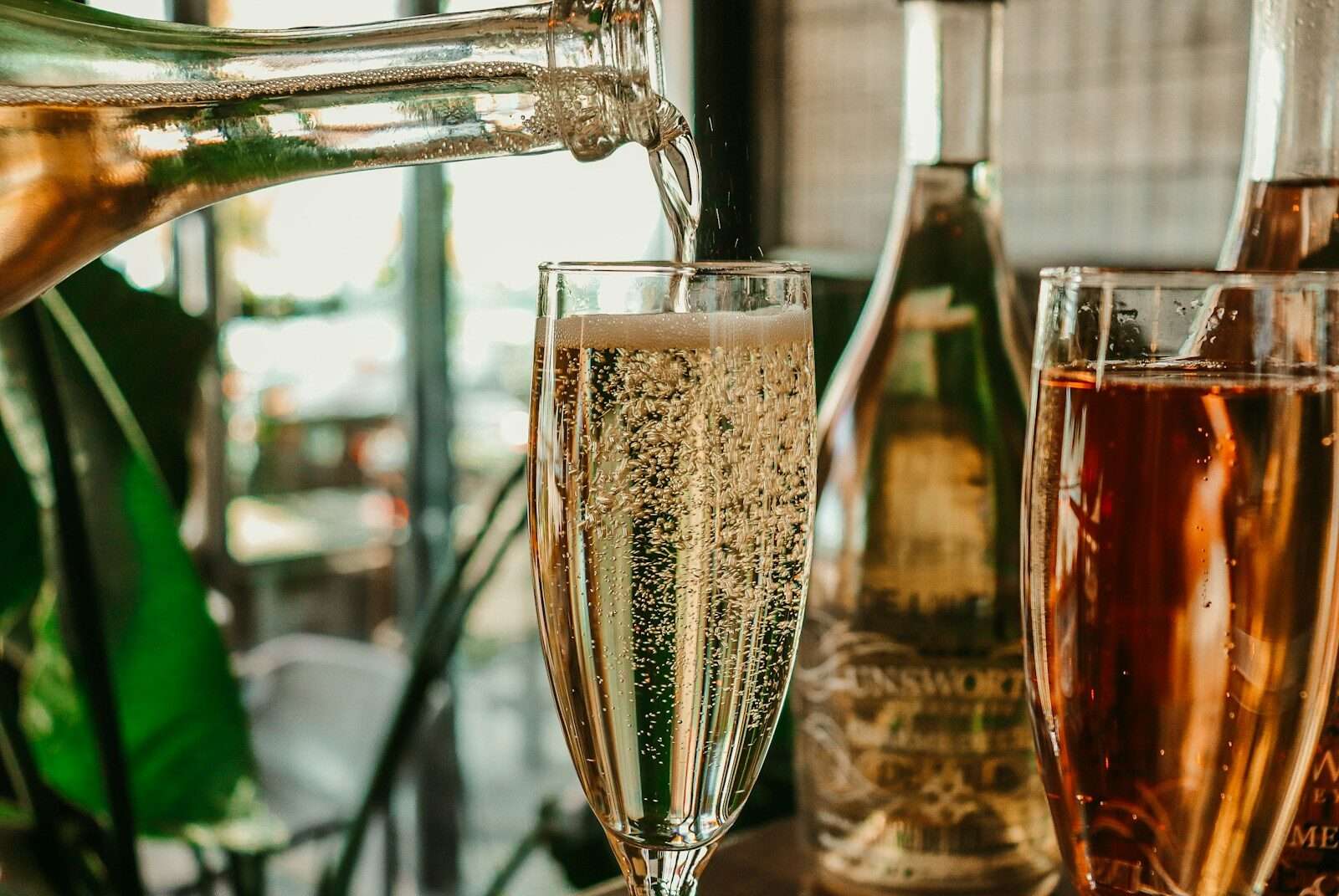
Pour slowly. Tilt the glass and pour down the side to preserve as many bubbles as possible.
Champagne and Food Pairing
Champagne is one of the most food-friendly wines in existence. Its acidity, effervescence, and mineral character cut through richness and complement delicate flavors simultaneously.
Classic pairings that work reliably:
- Oysters and raw shellfish — Blanc de Blancs is the definitive match
- Fried food — fried chicken, tempura, fish and chips — the bubbles are a revelation
- Sushi and sashimi — the minerality bridges the gap elegantly
- Aged hard cheeses — Comté, Parmigiano, Aged Gouda
- Charcuterie and cured meats — rosé Champagne especially
- Foie gras — with a Demi-Sec or Sec style
One pairing I keep coming back to: briny, creamy oysters with a lean, mineral Blanc de Blancs. There’s nothing else quite like it.
What Champagne Is Not
A few common misconceptions worth clearing up:
“Champagne” is not a synonym for all sparkling wine. Cava (Spain), Prosecco (Italy), Crémant (France, outside Champagne), Sekt (Germany), and American sparkling wines are distinct and different products. They can be excellent, but they’re not Champagne.
Expensive doesn’t always mean better for your palate. The prestige cuvées — Dom Pérignon, Cristal, Krug Grande Cuvée — are technically impressive and worth trying once. But a well-made grower Champagne at a third of the price might actually give you more pleasure depending on your preferences.
Champagne doesn’t need a special occasion. One of the best things you can do is open a bottle of good NV Brut with a weeknight dinner. The occasion becomes special because of the wine, not the other way around.
Champagne for Corporate Events and Team Experiences
There’s a reason Champagne has been the wine of celebration, negotiation, and deal-making for centuries — it’s a natural conversation catalyst. The ritual of opening a bottle, the shared anticipation, the way it pairs with almost any food — it creates the conditions for memorable moments.
At The Wine Voyage, Myrna Elguezabal designs corporate wine experiences where teams move through guided tastings together — including deep dives into Champagne styles, house comparisons, and food pairing exercises. These sessions are built on the idea that wine knowledge shared in a group is far more engaging than reading about it alone. Teams that taste Champagne together — comparing a grower’s Blanc de Blancs against a prestige NV, exploring the dosage spectrum — leave with both knowledge and a shared experience they’ll reference for years.
If you’re planning a team celebration, client dinner, or off-site event in the San Francisco Bay Area, a guided Champagne tasting is one of the most distinctive and memorable ways to do it.
If you enjoy exploring French sparkling wines, you’ll find useful context in the Prosecco guide for Italian comparison, and the Champagne vs Prosecco piece if you want a direct side-by-side. For broader French wine context, the Burgundy guide and Bordeaux guide fill in the continental picture. The wine regions guide gives you the geography to anchor it all.
Further Reading
For deeper exploration of Champagne, I recommend Wine Folly’s visual Champagne guide and Decanter’s Champagne coverage, which tracks house news, vintage reports, and blind tasting results.