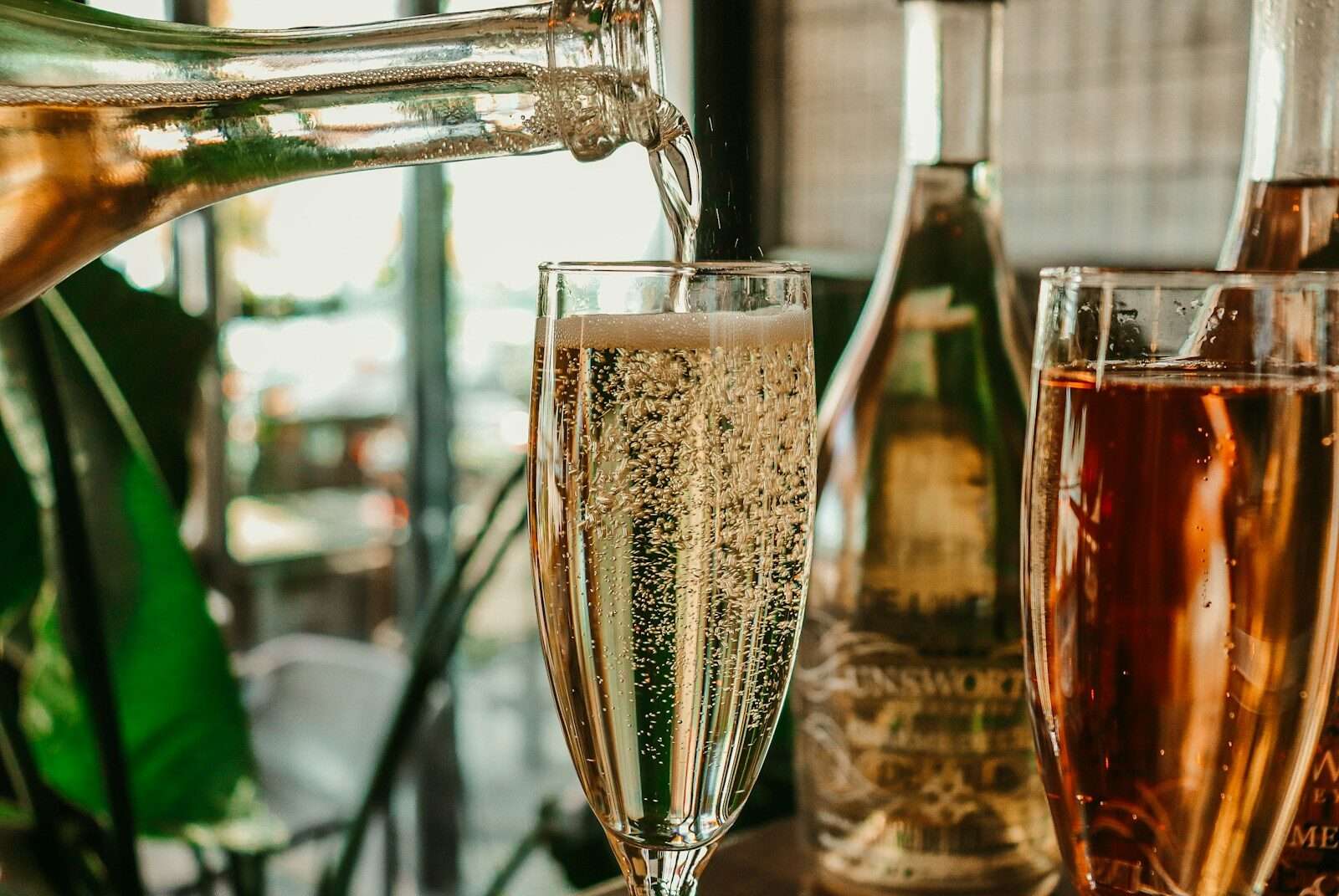
Champagne and Prosecco are both sparkling wines. They both come in elegant bottles. They’re both celebratory by association. Beyond that, they’re genuinely different products — different grapes, different production methods, different flavor profiles, and very different prices.
Here’s what the differences actually mean for what you buy, when, and for what.
Where They Come From
Champagne comes exclusively from the Champagne region of northeastern France, roughly 90 miles east of Paris. Champagne is a legally protected appellation — sparkling wine made anywhere else cannot be called Champagne under EU and most international trade law. American “Champagne” (still found on some older labels) is a grandfathered exception that legitimate French Champagne producers have fought against for decades.
The key grapes: Chardonnay, Pinot Noir, and Pinot Meunier — typically blended together, though single-variety (Blanc de Blancs from Chardonnay alone, or Blanc de Noirs from red grapes) versions exist.
Prosecco comes from northeastern Italy, primarily the Veneto and Friuli-Venezia Giulia regions. The key appellation is Conegliano-Valdobbiadene Prosecco Superiore DOCG, in the hills north of Venice. The grape is Glera (once also called Prosecco — the grape was renamed when the appellation was codified in 2009 to prevent non-Italian production using the grape name as a loophole).
How They’re Made: The Big Difference
This is the most important distinction and the one that explains almost every flavor difference.
Champagne: Traditional Method (Méthode Champenoise)
- A base wine is made (dry, high-acid, still wine)
- The base wine is blended across different vineyards and often different years (for non-vintage Champagne)
- A mixture of wine, sugar, and yeast is added to the bottle
- The bottle is sealed and the second fermentation happens inside the bottle
- The CO₂ produced by fermentation is trapped in the wine under pressure
- The wine ages in the bottle on its lees (dead yeast cells) for a minimum of 15 months for non-vintage, 36 months for vintage — often much longer
- The yeast is removed (a process called riddling and disgorgement)
- A small amount of wine and sugar (the dosage) is added before final corking
The result: Bubbles that are smaller, finer, and more persistent — they form more slowly and stay in the wine longer. And critically, the aging on the lees creates the characteristic Champagne flavors: brioche, toast, pastry, biscuit, cream. These autolytic flavors don’t come from the grapes — they come from extended contact with the dead yeast cells.
Prosecco: Tank Method (Charmat or Martinotti Method)
- A still base wine is made from Glera grapes
- The base wine goes into a large pressurized tank with sugar and yeast
- The second fermentation happens in the tank (not in the bottle)
- The resulting sparkling wine is filtered and bottled under pressure
The result: Larger, less persistent bubbles. No autolytic aging, so no brioche or toast character. The focus is on primary fruit — peach, apricot, pear, white flower. Fresh, aromatic, immediately approachable.
The tank method also means Prosecco can be produced much faster and at higher volume than Champagne. This is partly why Prosecco is generally significantly cheaper.
How They Taste
Champagne:
- More complex, layered aromas — green apple, lemon, white peach, then secondary notes of brioche, toast, cream, nuts, sometimes mushroom in aged examples
- Smaller, finer bubbles
- Drier and higher in acidity (especially Brut and Extra Brut)
- Longer finish
- More savory, umami-forward in older vintages
- Chardonnay-dominant Champagne (Blanc de Blancs) feels lean and mineral; Pinot Noir-dominant examples feel fuller and red-fruited
Prosecco:
- Simpler, more aromatic — fresh peach, apricot, pear, white flowers, cream
- Slightly larger bubbles
- Often slightly less acidic than Champagne, slightly more approachable
- Shorter finish
- What it lacks in complexity it makes up in freshness and approachability
- No autolytic (toast/biscuit) character
The honest summary: Champagne is more complex and interesting to analyze. Prosecco is more immediately easy and enjoyable. Neither is wrong — they serve different purposes.
Sweetness Levels: Understanding the Labels
Both Champagne and Prosecco use the same sweetness scale, from driest to sweetest:
| Label | Residual sugar | Taste |
|---|---|---|
| Extra Brut / Brut Nature | 0–6 g/L | Very dry, almost stark |
| Brut | < 12 g/L | Dry — the most common style |
| Extra Dry (Extra Sec) | 12–17 g/L | Slightly off-dry — confusingly, this is sweeter than “Brut” |
| Sec | 17–32 g/L | Noticeably sweet |
| Demi-Sec | 32–50 g/L | Medium sweet |
| Doux | > 50 g/L | Very sweet |
Important: “Extra Dry” Prosecco is sweeter than “Brut” Prosecco. The terminology is counterintuitive — “Extra Dry” means slightly less dry than Brut, not extra dry.
Most of the Prosecco sold in restaurants and bars is Extra Dry — which has perceptible sweetness. If you want drier Prosecco, look for “Brut” specifically.
Most Champagne sold is Brut — genuinely dry.
Price Differences and Why
Champagne ranges from around $35 for basic non-vintage bottles to $300+ for prestige cuvées (Dom Pérignon, Krug, Cristal). Even entry-level Champagne is notably more expensive than Prosecco.
Prosecco ranges from $12 to $35 for most bottles, with Conegliano-Valdobbiadene Superiore DOCG topping out around $40–50 for the best single-vineyard examples (Rive-designated).
Why the price difference?
- Labor: Riddling and disgorgement (removing yeast from individual bottles) is labor-intensive, especially for smaller producers
- Aging requirements: Champagne spends years in the cellar; Prosecco is typically released months after harvest
- Prestige: The Champagne brand is global, with marketing spend to match
- Regulations: French appellation rules limit yields and require specific practices that increase cost
Is Champagne worth the price premium? For the best examples, yes — the complexity and aging potential justify it. For everyday toasting, Prosecco and other high-quality sparkling wines (Cava from Spain, Crémant from France) offer tremendous value.
When to Choose Each
Choose Champagne when:
- You want something complex to sip and analyze with full attention
- You’re pairing with food that calls for the autolytic character (oysters, caviar, fried foods, rich chicken dishes)
- The occasion has real significance and you want the bottle to match it
- You want something that will reward aging (vintage Champagne)
- You’re serving serious wine drinkers who will notice the difference
Choose Prosecco when:
- You want something approachable, easy, and crowd-pleasing
- You’re making Aperol Spritz or Hugo cocktails (Prosecco’s flavors work better in cocktails than Champagne’s)
- Budget is a factor and you need more than one bottle
- The occasion is casual-celebratory (brunch, birthday, post-work gathering)
- You’re pairing with lighter food — charcuterie, bruschetta, light appetizers
The honest advice: For toasting, Prosecco is completely appropriate and often preferred. For serious food pairing or occasions where you want the best, Champagne is worth the money.
What About Cava, Crémant, and Others?
Cava — Spain’s sparkling wine made by the traditional method (same as Champagne). Uses Spanish grapes (Macabeo, Xarello, Parellada). Complex, bready character similar to Champagne at a fraction of the price. Outstanding value, often underappreciated.
Crémant — French sparkling wine from regions other than Champagne, also made by the traditional method. Crémant d’Alsace, Crémant de Loire, Crémant de Bourgogne — all share Champagne’s production method and often its grape varieties, at roughly half the price.
Pétillant Naturel (Pét-Nat) — Natural, slightly rustic sparkling wine made by the “ancestral method” — bottled before fermentation completes. Lightly fizzy, cloudy, and slightly rustic. The fastest-growing sparkling wine trend in natural wine circles.
Champagne Styles and Types
Non-Vintage (NV): The most common style. Blends wine from multiple years to achieve a consistent “house style.” Minimum 15 months aging.
Vintage: Made from a single exceptional year’s harvest. Minimum 36 months aging (often much more). More expensive and made in limited quantities.
Blanc de Blancs: Made exclusively from Chardonnay. Lean, mineral, citrus-forward.
Blanc de Noirs: Made from Pinot Noir and/or Pinot Meunier (red grapes, pressed to white juice). Fuller, more red-fruited.
Rosé: Pink Champagne — typically blended with a small percentage of still Pinot Noir. More complex and food-versatile than white Champagne.
Prestige Cuvée: Each house’s flagship bottle — Dom Pérignon (Moët), Krug Grande Cuvée, Belle Époque (Perrier-Jouët), Cristal (Louis Roederer). Made from the best grapes and aged longer.
Prosecco Quality Levels
Prosecco DOC: Basic appellation, broad geographic area. Most of the $12–18 bottles at grocery stores.
Prosecco Superiore DOCG: Higher-quality designation. Two sub-zones:
- Conegliano Valdobbiadene Prosecco Superiore DOCG — the premium zone, hilly terrain, better terroir expression
- Asolo Prosecco Superiore DOCG — smaller, newer DOCG
Cartizze: Within Valdobbiadene, a 107-hectare Grand Cru area. The most prestigious Prosecco designation, typically richer and slightly sweet.
Rive: Single-vineyard Prosecco from Conegliano Valdobbiadene. The most terroir-specific Prosecco available.
Storing and Serving
Champagne: Serve at 40–45°F (4–7°C). Vintage Champagne benefits from opening 30 minutes before serving and can improve with gentle decanting. Store non-vintage Champagne for up to a few years; vintage Champagne for decades.
Prosecco: Serve at 40–45°F (4–7°C). Unlike Champagne, Prosecco doesn’t benefit from aging — drink it within 1–2 years of vintage. The fresh fruit character that defines it fades quickly.
Both: Use a flute or tulip glass to preserve bubbles and concentrate aromatics. Avoid wide coupe glasses that cause bubbles to dissipate quickly (though they look good in photos).
For more on sparkling wine serving: see wine serving temperatures. For pairing sparkling wine with food: the wine pairing guide covers the sparkling wine principle. And for the sweet wine side of sparkling: sweet wine guide.