Knowing how to host a blind wine tasting is one of the most useful things you can learn if you love wine, love hosting, or love watching people discover they have stronger opinions about Chardonnay than they thought.
I’ve hosted hundreds of blind tastings — for corporate groups, birthday parties, anniversary dinners, and team-building events. Every single time, someone who walked in saying “I don’t really know wine” walks out having made four confident guesses and won a round. That’s the magic of a well-run blind tasting: it proves that taste is democratic.
Here’s exactly how to host a blind wine tasting, whether you’re doing it for six friends on a Friday night or sixty colleagues at an offsite.
What Is a Blind Wine Tasting?
In a blind wine tasting, the identity of each wine is hidden from the tasters. Labels are covered, bottles are wrapped, and wines are poured into numbered glasses. Participants taste and evaluate each wine without knowing what it is — then guess the grape, region, price point, or whatever criteria you’ve set.
The “blind” element does two things:
- Removes bias — People evaluate what’s actually in the glass rather than what they expect based on the label or price.
- Levels the playing field — A $15 wine from a grocery store regularly beats a $100 bottle in blind tastings. It’s humbling, hilarious, and surprisingly educational.
Step 1 — Choose Your Format
How you structure the tasting determines everything else. Pick one of these formats before you do anything else:
| Format | Best For | Difficulty |
|---|---|---|
| Grape variety comparison | Learning wine basics, beginners | Easy |
| Price point challenge | Myth-busting, party crowd | Easy |
| Old World vs. New World | Wine enthusiasts, dinner parties | Moderate |
| Region spotlight | Deep dives, wine education | Moderate |
| Vintage comparison | Advanced groups, collectors | Hard |
My recommendation for first-timers: The price point challenge. Choose 4–5 wines ranging from $12 to $60, all the same varietal (Cabernet Sauvignon works perfectly). Ask everyone to rank them by price. The results are consistently surprising and generate the most conversation.
Step 2 — Select Your Wines
For how to host a blind wine tasting that flows well, I recommend 4–6 wines for a casual tasting and up to 8 for a dedicated wine education session. Beyond 8, palate fatigue sets in and people start guessing randomly.
Pour sizes: 1–1.5 oz per wine per person. A standard 750ml bottle holds about 25 oz, so one bottle serves 15–25 tasters at blind tasting portions.
Quantity formula:
- Number of guests × number of wines × 1.5 oz = total oz needed
- Divide by 25 to get bottles needed (round up)
For 12 guests tasting 5 wines: 12 × 5 × 1.5 = 90 oz ÷ 25 = 3.6 → buy 4 bottles of each.
Tips for wine selection:
- Stick to one varietal when comparing price points — it isolates the variable
- Include one obvious outlier if you want a teaching moment
- Buy at least one wine people have heard of (psychological benchmark)
- Serve whites before reds, lighter before fuller-bodied
Step 3 — Set Up Your Tasting Station
This is where attention to detail pays off. A sloppy setup breaks the blind — people will figure out what they’re drinking if they can see labels through the bag.
What you need:
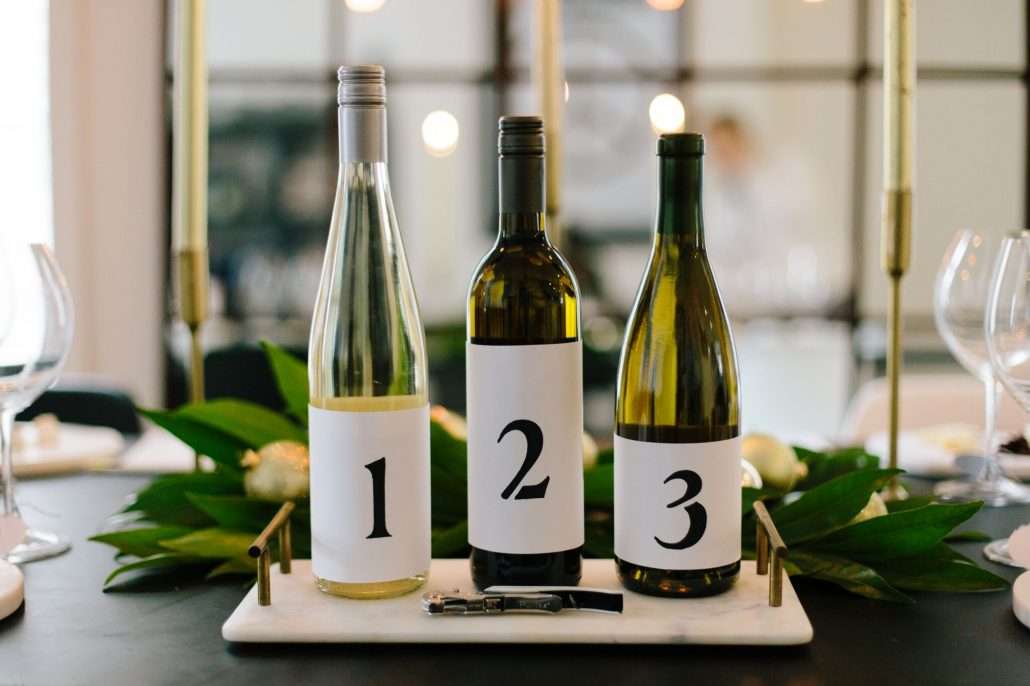
- Brown paper bags or foil to wrap bottles (tape securely)
- Numbered labels or stickers (1, 2, 3…)
- One glass per wine per person — or a rinse glass if you’re reusing
- A water pitcher and crackers/bread for palate cleansing
- Scorecards (see below)
- Pens
Glass setup: If you have enough glasses, set out all glasses pre-poured before guests arrive. This speeds up service and prevents people from watching you pour. If reusing glasses, provide a rinse glass and a dump bucket, and remind people to rinse between wines.
Room temperature matters: Serve whites at 45–50°F, reds at 60–65°F. Pull whites from the fridge 20 minutes before service. Too cold kills aroma; too warm accelerates it.
Step 4 — Create Your Scorecard
A good scorecard for a blind wine tasting gives people a framework to evaluate what’s in their glass. Keep it simple.
For a price point challenge, your scorecard just needs:
For a grape/region identification format:
You can download scorecard templates online, but honestly a simple handwritten version works just as well. The act of writing down observations is what trains people to pay attention.
Step 5 — Run the Tasting
Here’s the flow that works every time:
1. Brief everyone (5 minutes). Explain the format, scoring, and house rules. Emphasize that wrong guesses are not embarrassing — the wines are designed to fool people.
2. Taste in order. Move through wines 1, 2, 3 in sequence. Give people 3–4 minutes per wine — enough to smell, taste, and make notes without overthinking.
3. No sharing guesses mid-tasting. Save discussion for the reveal. Shared opinions contaminate individual responses and reduce the fun of comparing guesses afterward.
4. Palate cleanse between wines. Water and plain crackers. Avoid cheese or charcuterie during the tasting itself — fat coats the palate and makes discrimination harder. Save those for after the reveal.
5. Collect scorecards before the reveal. If you’re running a competition, you want committed answers before anyone changes their mind.
6. The reveal. This is the moment. Unwrap bottles one at a time, announce what each wine actually is, and watch people’s reactions. Read out a few scorecards. Announce winners. Discuss.
Step 6 — Lead the Discussion
Knowing how to host a blind wine tasting well means being able to guide the conversation after the reveal. You don’t need to be a sommelier. You need to be curious and ask good questions:
- “Who was most surprised by Wine #3?”
- “Did anyone get the price order right? What gave it away?”
- “What did you notice about Wine #2 that you couldn’t put into words?”
The discussion is where people learn — and where the real bonding happens. Give it at least 20 minutes.
Hosting for Groups vs. Hosting for Teams
Hosting for a dinner party of 8 and hosting a blind wine tasting for a team of 40 require different logistics, but the same core principles.
For larger groups:
- Pre-pour all wines into numbered glasses and cover them with an index card
- Use a projected scorecard or shared Google Form instead of paper cards
- Divide into tables of 6–8 with a designated table captain who leads discussion
- Consider a roving facilitator (or hire one) to keep energy up
For corporate team building: The blind wine tasting is one of the most effective team building ideas for work precisely because it requires no prior expertise, rewards attentiveness, and generates organic conversation. We’ve run this format for groups from 10 to 200 at The Wine Voyage — it scales reliably.
The key difference in a corporate context is the reveal. In a friend group, the reveal is entertainment. In a team context, it’s also a lesson in perspective and bias — people made confident guesses based on incomplete information. Sound familiar?
Common Mistakes to Avoid
Serving too many wines. Six is usually plenty. Eight is the maximum before the tasting becomes a chore.
Not chilling the whites enough. Warm white wine doesn’t just taste worse — it gives the varietal away faster, ruining the blind.
Skimping on glasses. One glass per wine per person is ideal. Rinsing and reusing glasses is fine, but remind people often. One trace of red in a white tasting glass skews everything.
Making the reveal too rushed. This is the payoff. Don’t sprint through it.
Forgetting non-drinkers. Always have sparkling water or a non-alcoholic option for guests who don’t drink. The game works just as well — they’re guessing characteristics, not relying on alcohol knowledge.
For a fully guided experience, check out our wine tasting team building events, or read about wine tasting games for groups for more competition formats. If you’re new to wine evaluation, how to taste wine is a great primer before hosting your first event.
Further Reading
Go deeper on blind tasting technique and wine evaluation: Wine Folly’s Guide to Tasting Wine and Guild of Sommeliers: Introduction to Blind Tasting.