I came to whiskey late. For years I was a committed wine person — grapes, terroir, vintage variation, all of it. Then a client pulled out a 21-year Speyside Scotch at the end of a corporate event I was running, poured two glasses, and said nothing. Just slid one across the table.
That first proper whiskey tasting moment — really nosing the glass, letting the spirit open, finding the vanilla and dried fruit and that faint thread of smoke — changed something for me. I realized I’d been treating whiskey as a category to drink through rather than one to actually taste.
This guide is what I wish I’d had then. Whether you’re brand new to whiskey tasting or you’ve been sipping for years without a real framework, here’s how to slow down, pay attention, and get significantly more out of every glass.
What Is Whiskey Tasting, Really?
Whiskey tasting is the practice of evaluating a spirit systematically — using your eyes, nose, and palate to understand what’s in the glass and why it tastes the way it does. It’s not about being pretentious. It’s about paying attention.
The skills that make someone good at whiskey tasting are learnable. You don’t need a special palate. You need practice, a framework, and the willingness to articulate what you’re experiencing rather than just swallowing.
The same approach that wine professionals use for sensory evaluation applies beautifully to whiskey. Color, aroma, palate, finish — these four stages give you a repeatable structure that works whether you’re tasting a $25 bottle or a $250 collector release.
The Four Categories of Whiskey You’ll Encounter
Before you can taste whiskey intelligently, it helps to know what you’re tasting. The major style categories produce genuinely different flavor profiles.
| Style | Base Grain | Key Region | Flavor Profile |
|---|---|---|---|
| Scotch Single Malt | Malted barley | Scotland | Smoke, dried fruit, maritime, heather |
| Bourbon | At least 51% corn | USA (Kentucky) | Vanilla, caramel, oak, baking spice |
| Irish Whiskey | Barley (malted and unmalted) | Ireland | Light, floral, smooth, often triple-distilled |
| Japanese Whisky | Malted barley / blends | Japan | Delicate, precise, fruit, subtle smoke |
| Rye Whiskey | At least 51% rye | USA / Canada | Spicy, peppery, herbal, dry finish |
| Tennessee Whiskey | Corn-heavy mash | Tennessee | Similar to bourbon but charcoal-filtered |
These aren’t rigid rules — there’s enormous variation within each category. But knowing the category tells you what to expect and helps you identify when a whiskey is doing something unusual.
The Whiskey Tasting Framework: Four Steps
Step 1: Look at the Color
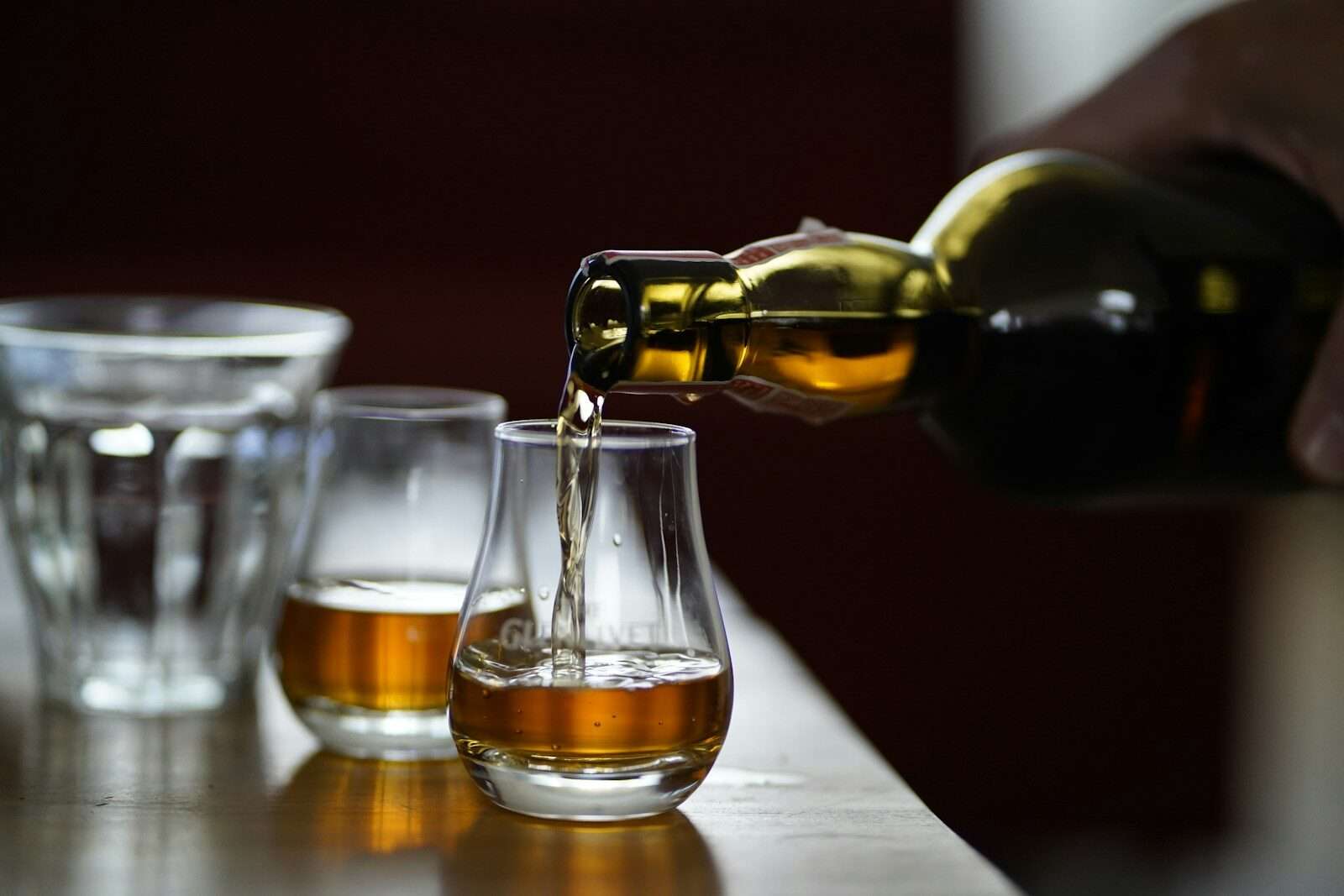
Pour an ounce or so into a tulip-shaped glass (a Glencairn glass is ideal, but any wine glass will do). Hold it up to the light.
Color in whiskey comes almost entirely from barrel aging. Pale gold suggests a younger spirit or an ex-bourbon barrel. Deep amber or mahogany points to longer aging, sherry casks, or both. Note whether the color is brilliant or slightly hazy — many craft distilleries skip chill-filtration, which can create a slight cloudiness, actually a sign of more natural production.
When you tilt the glass, watch the “legs” run down the sides. Heavier, slower legs indicate higher alcohol or higher sugar content. It’s not a quality indicator exactly, but it tells you something about the spirit’s body.
Step 2: Nose the Glass
This is where most of the flavor information lives. Humans can detect thousands of aroma compounds — far more than our palates can distinguish. The nose is the real story.
Start with the glass a few inches from your face. Take a soft sniff. You’re orienting yourself — what’s the dominant first impression? Grain? Fruit? Oak? Something smoky?
Then bring the glass closer and inhale more deeply. Let yourself go slowly through mental categories:
- Fruit: apple, pear, citrus, dried fruit, tropical
- Grain: corn, cereal, malt, bread
- Wood: vanilla, coconut, oak tannins, char
- Spice: cinnamon, ginger, pepper, clove
- Floral: heather, honey, perfume
- Smoke: peat, campfire, medicinal (especially in Islay Scotch)
Don’t rush this. The aroma of a quality whiskey evolves in the glass. The notes you catch at two minutes may be completely different from what you find at ten.
Step 3: Taste — and Add Water
Take a small sip and let it sit on your palate before swallowing. Where do you feel it first? What hits the front of your tongue, the middle, the back?
After that first sip, add a few drops of still water. This is not a sign of weakness — it’s technique. Water opens up whiskey by releasing volatile aroma compounds and lowering the proof, which helps the palate detect more complexity. Professional tasters almost always add a little water.
Taste again with water added. Compare:
- Entry: the first flavor impression
- Development: how the flavors evolve mid-palate
- Body: light and watery, or rich and full?
Common palate notes to look for: vanilla, toffee, honey, dried cherries, cinnamon, baking spices, nuts, malt, char.
Step 4: Evaluate the Finish
The finish is what lingers after you swallow — and it matters. A long, complex finish is generally a sign of quality. A short, hot, or flat finish suggests a less refined spirit or something that was rushed to market.
Ask yourself: How long does the finish last — seconds or minutes? Does it shift as it fades? Is it warming, drying, sweet, smoky, or spicy? Does it leave you wanting another sip?
Great whiskeys often reveal their best character in the finish. That’s when the heat has dissipated and what remains is the pure distilled and aged character.
Building a Vocabulary for Whiskey Tasting
One barrier people hit when they start whiskey tasting is not having words for what they’re experiencing. The solution isn’t memorizing flavor descriptors — it’s training your sensory memory.
Keep a small notebook, or use your phone. After each tasting, write down three to five descriptors even if they seem silly (“reminds me of a Christmas candle” is actually useful). Over time, you’ll build a personal reference library.
A few common categories and what they signal:
Vanilla and caramel — almost always oak-derived, particularly from new American oak barrels as used in bourbon production. If you smell vanilla strongly, the whiskey likely spent time in American oak.
Dried fruit (raisins, figs, dates) — often from sherry cask aging. Scotch aged in ex-sherry butts tend toward these notes. It’s a classic Speyside signature.
Peat and smoke — a specific style associated with Islay Scotch and some Japanese whiskies. The peat is used to dry malted barley over a fire. Intensities vary from a gentle whisper (Bowmore) to a wall of smoke (Octomore).
Floral and honeyed — lighter, more delicate whiskies, often from lighter stills or shorter aging. Irish whiskeys and Lowland Scotches frequently lean this direction.
How to Approach a Whiskey Tasting Flight
When tasting multiple whiskies — which is the best way to develop your palate — order matters. Move from lighter to heavier:
- Start with a lighter Irish or Japanese whisky
- Progress to a bourbon or rye
- End with heavily peated Scotch or high-proof expressions
Cleanse your palate between pours with plain still water. Some people use unsalted crackers or plain bread, though I find plain water is sufficient for most sessions.
Taste no more than six to eight expressions in a single session. Palate fatigue is real, and after too many samples you’ll stop tasting accurately.
Common Mistakes in Whiskey Tasting
Tasting too cold. Cold suppresses aroma. Let your whiskey reach room temperature before nosing it.
Using the wrong glass. A wide tumbler disperses aroma. A tulip-shaped or copita glass concentrates it. This makes a meaningful difference.
Dismissing a whiskey too quickly. Some whiskies need ten minutes in the glass to open up. What smells harsh or closed at first can become remarkably complex with time and air.
Skipping the nose. Most people go straight to sipping. The nose is where you find the most information. Spend real time there.
Not adding water. Especially with cask-strength expressions (55%+ ABV), a few drops of water will significantly improve the experience.
Bringing Whiskey Tasting to a Group
I’ve run whiskey tasting experiences for corporate groups many times, and they work beautifully — the structure gives people something to talk about, and whiskey’s story (grain, distillery, barrel, time) gives context that makes the tasting feel substantive rather than just drinking.
The best formats for group whiskey tasting:
- Side-by-side comparisons (bourbon vs. rye, or same distillery at different ages)
- Blind tasting flights where participants guess the category or region
- Progressive storytelling — starting with grain-forward unaged spirit, then barrel samples, then finished whiskey, to show what aging actually does
These same principles power The Wine Voyage’s tasting experiences. While we’re rooted in wine, our Tequila & Mezcal Experience uses an identical sensory framework — nose, palate, finish, comparison — and many of the same group dynamics that make whiskey tastings so effective for teams. Corporate groups find that structured spirit tasting builds the kind of genuine conversation that no keynote or workshop can replicate.
Building a Home Whiskey Tasting Collection
You don’t need dozens of bottles. A focused starter collection of three to five expressions will teach you more than a cabinet full of random bottles:
- A bourbon — Buffalo Trace or Wild Turkey 101 for value; something like Blanton’s for a treat
- An Irish whiskey — Redbreast 12 or Green Spot
- A Speyside Scotch — Glenfiddich 15 or GlenDronach 12
- An Islay Scotch — Laphroaig 10 or Ardbeg 10 (to understand peat)
- A Japanese whisky — Nikka from the Barrel when you can find it
Taste them side by side against each other over time. This is how you build real understanding of the categories — not from reading, but from experiencing the contrast.
If you’re curious how structured tasting experiences work for groups, explore our posts on wine tasting team building and how to host a blind wine tasting — the frameworks translate directly. For an overview of how to approach any tasting session, how to taste wine covers the fundamentals that apply across all fine beverages.
Further Reading
For deeper dives into whiskey production, regions, and reviews, two excellent resources are Whisky Advocate for in-depth reviews and industry news, and Master of Malt’s blog for accessible education on distilleries, cask types, and tasting technique.