Chardonnay is the most planted white wine grape in the world, and also the most polarizing. Some people love it and drink it exclusively. Others have sworn off it entirely after years of overoaked, butter-bomb California versions. Both groups are mostly reacting to a specific style, not to the grape itself.
Chardonnay has no strong flavor signature of its own — it’s one of the most neutral and adaptable white grapes. What you taste in Chardonnay is largely what the winemaker decided to do with it. Understanding those decisions is the key to finding Chardonnay you actually like.
What Chardonnay Tastes Like
Chardonnay’s flavor depends enormously on where it’s grown and how it’s made. There are several distinct style categories:
Unoaked / Lightly Oaked Chardonnay
No oak barrel aging or very brief contact. Fermented and aged in stainless steel or neutral (old) oak barrels.
Flavors: Green apple, lemon, lime, white peach. Fresh, crisp, clean. The wine tastes primarily of fruit and terroir — you can actually taste the place because the winemaking doesn’t obscure it.
Examples: Chablis (the archetype), Mâcon-Villages, many Italian Chardonnay, unoaked versions from cooler-climate producers in California and Australia.
Body: Light to medium. High acidity. No butteriness or creaminess.
Lightly Oaked Chardonnay
Partial barrel fermentation or aging, often in larger barrels (which impart less oak character). Some texture and complexity without dominant oak flavors.
Flavors: Apple, pear, citrus, subtle vanilla or toast, gentle cream. The oak is a supporting element.
Examples: White Burgundy from Côte de Beaune (Meursault, Puligny-Montrachet), many Oregon Chardonnay, some New Zealand examples.
Body: Medium. More texture than unoaked, still fresh acidity.
Heavily Oaked Chardonnay (The “Butter Bomb” Style)
Barrel-fermented, aged in new oak barrels, often with malolactic fermentation (converts sharp malic acid to softer lactic acid — the process that creates a buttery, creamy texture). This is the style that made California Chardonnay famous in the 1980s–1990s and that many people love or hate.
Flavors: Butter, cream, vanilla, caramel, tropical fruit (mango, pineapple, banana), toasted oak. The oak and malolactic conversion dominate.
Examples: Many Napa Valley Chardonnay, commercial Australian Chardonnay, entry-level California Chardonnay.
Body: Full. Low acidity (converted by malolactic). Rich and heavy on the palate.
Where Chardonnay Comes From: Key Regions
Burgundy (Côte d’Or and Chablis), France
The benchmark for elegant, complex, age-worthy Chardonnay. Burgundy’s Chardonnay is labeled by place (Chablis, Meursault, Puligny-Montrachet) rather than grape variety.
Chablis — the most distinctive Chardonnay style. No oak (or very little), extremely cold climate, Kimmeridgean chalk and limestone soils. The result is lean, stony, intensely mineral Chardonnay with high acidity and a characteristic “flintiness” or “oyster shell” note. Nothing else tastes like great Chablis.
Classification: Petit Chablis → Chablis → Chablis Premier Cru → Chablis Grand Cru (the seven Grand Cru vineyards are the finest).
Côte de Beaune (Meursault, Puligny-Montrachet, Chassagne-Montrachet) — the heartland of great white Burgundy. These wines combine the mineral precision of Chablis with more richness and texture from the Côte d’Or’s limestone and clay soils. Usually aged in oak, but not dominated by it. Capable of aging 10–20+ years.
Notable Grand Cru: Montrachet, Bâtard-Montrachet, Corton-Charlemagne — among the most expensive and celebrated white wines in the world.
Mâconnais — the southernmost Burgundy sub-region, producing friendly, approachable Chardonnay at more accessible prices. Mâcon-Villages, Pouilly-Fuissé, Saint-Véran.
California (Napa Valley, Sonoma)
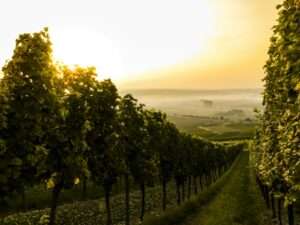
California produces enormous quantities of Chardonnay in the full spectrum of styles. The key distinction is between warmer valley-floor sites (more tropical, oakier styles) and cooler coastal and elevated sites (more acidic, restrained).
Russian River Valley and Sonoma Coast produce California’s most elegant Chardonnay — influenced by Pacific fog, higher acidity, more mineral, less tropical.
Napa Valley Chardonnay tends toward richer, more opulent styles.
Santa Barbara (particularly Sta. Rita Hills) produces exciting cool-climate Chardonnay with bright acidity and terroir specificity.
Oregon (Willamette Valley)
Oregon Chardonnay has emerged as one of the most exciting American styles. Cooler climate than most of California, producers often use Burgundian production methods. The wines have a precision and restraint closer to white Burgundy than to California.
Australia
Australian Chardonnay has evolved dramatically. Older-style Australian Chardonnay was notorious for heavy oak and tropical fruit. The modern generation, particularly from Margaret River (Western Australia), Yarra Valley (Victoria), and Adelaide Hills (South Australia), produces restrained, food-friendly, elegant Chardonnay.
New Zealand (Marlborough, Hawke’s Bay)
New Zealand Chardonnay is typically fresh, vibrant, and moderately oaked. Hawke’s Bay on the North Island produces some of the country’s best — rich but balanced.
Chablis Look-Alikes
If you love Chablis but want alternatives:
- Mâcon-Villages (also Burgundy, slightly less mineral, more accessible price)
- Verdicchio from Italy (not Chardonnay, but similar profile — mineral, crisp, unadorned)
- Muscadet (not Chardonnay either, but the same “wine that gets out of the way” philosophy)
The Malolactic Fermentation Question
Malolactic fermentation (MLF) is the bacterial process that converts tart malic acid (like in green apples) into softer lactic acid (like in milk). It’s the single biggest technical decision in Chardonnay production and determines much of the style.
Full MLF: Butter, cream, round texture, low acidity. The California butter-bomb style.
No MLF: Crisp, bright, tart, high acidity. Chablis style.
Partial MLF: A balance — some texture and richness without losing acidity. White Burgundy’s typical approach.
When you’re reading about a Chardonnay and see “no malolactic fermentation” or “100% malolactic,” that’s one of the most useful style cues available.
Food Pairing With Chardonnay
Unoaked / Chablis style:
- Oysters and shellfish (the classic Chablis pairing — the mineral quality matches the brininess)
- Light white fish (sole, halibut, sea bass)
- Simple grilled chicken
- Fresh goat cheese
- Sushi and sashimi
- Anything delicate where an oaked wine would overwhelm
Lightly oaked, white Burgundy style:
- Roast chicken, especially with cream sauce or herbs
- Lobster and crab (with butter — the richness calls for a richer wine)
- Risotto (mushroom or seafood)
- Veal
- Brie and Camembert
- Salmon
- Scallops
Heavily oaked California style:
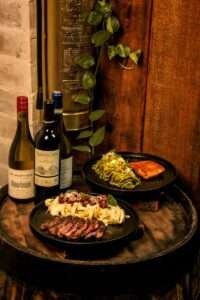
- Creamy pasta (Alfredo, carbonara)
- Rich chicken dishes (chicken in cream sauce, chicken pot pie)
- Buttery seafood (lobster thermidor)
- Dishes with cream, butter, or cheese as a central element
- Popcorn (this is a well-known, legitimate pairing)
- By itself, as a sipping wine
What Chardonnay doesn’t pair well with:
- Spicy food — the low acidity in oaked versions amplifies heat
- Red meat — the tannin / white wine mismatch
- Very light salads — the oak dominates
Reading a Chardonnay Label
“Unoaked” or “No Oak” on the label: the wine hasn’t been in new oak barrels. Expect fresh, lean, fruit-forward.
“Reserve” in California: Usually means more oak and richer. Not a regulated term in the US — producers use it how they choose.
“Burgundy” appellation: Côte de Beaune wines (Meursault, Puligny, etc.) are usually lightly to moderately oaked; Chablis is essentially unoaked.
The vintage matters: Burgundy vintages are significantly different year to year — acidity, ripeness, and whether the wine ages vary substantially. 2019, 2017, and 2015 are considered strong recent white Burgundy vintages.
Producers to Know
Burgundy (Chablis): William Fèvre, Domaine Raveneau, René et Vincent Dauvissat, Domaine Laroche.
Burgundy (Côte de Beaune): Domaine Leflaive, Coche-Dury, Roulot, Comte Lafon, Louis Jadot, Joseph Drouhin.
California (elegant style): Littorai, Ceritas, Aubert (more opulent), Ramey, Mount Eden.
California (approachable): Sonoma-Cutrer, Jordan, La Crema, Mer Soleil.
Oregon: Beaux Frères, Bethel Heights, Adelsheim, Domaine Drouhin Oregon.
Australia: Leeuwin Estate (Margaret River), Giaconda (Beechworth), Shaw + Smith (Adelaide Hills).
The ABCs of Avoiding Bad Chardonnay
- “ABC” drinkers (“Anything But Chardonnay”) are usually reacting to heavily oaked California Chardonnay from the 1990s–2000s. If that describes you, try Chablis or a lightly oaked Burgundy before swearing off the grape entirely.
- Look at the region: Chablis and most white Burgundy is naturally restrained. Most cheap California Chardonnay labeled “California” (without a specific region) is heavily oaked.
- Check the alcohol level: Lower-alcohol Chardonnay (12–13.5%) tends to be more restrained and food-friendly. Higher-alcohol (14.5%+) is usually riper and oakier.
- Vintage white Burgundy needs time: A Premier Cru Meursault that’s 1–3 years old often tastes closed and awkward. Give it 5–7 years and it opens into something different.
For the structural context on Chardonnay’s body: see our medium-bodied white wine guide — Chardonnay appears in both the lighter (unoaked) and fuller-bodied (oaked) categories. For food pairing: how to pair wine with food. And for serving temperature: wine serving temperatures by style.
Further Reading
For precise ratings and vintage assessments on white Burgundy, Burghound specializes in Burgundy at depth. For California Chardonnay coverage and vintage assessments, Wine Spectator’s California Chardonnay section is the reference of choice.