
I’ve been producing corporate events for over 15 years, and the most common thing I hear from event planners and HR managers is this: “We need team building ideas for work that people won’t dread.”
Fair. The reputation of team building activities is… not great. Trust falls. Mandatory fun. That one ropes course where someone sprained an ankle. I get it.
But here’s what I’ve learned from running hundreds of corporate events: the difference between team building people love and team building people endure comes down to one thing — does it give people something to experience together, or does it make them perform for each other?
The best team building ideas for work create shared memories, lower people’s guards, and generate the kind of inside jokes and conversation that carry over into the office for months. Below are 15 ideas I’ve seen work exceptionally well — from free activities to premium experiences.
What Makes Team Building Actually Work
Before the list, a quick framework. The best team building ideas for work share a few traits:
| What Works | What Doesn’t |
|---|---|
| Participation is optional within the activity | Forced vulnerability |
| Everyone can join regardless of fitness/background | Physically demanding activities that exclude |
| Generates natural conversation | Structured “share something personal” prompts |
| Has a clear, fun objective | Abstract “exercises” with no payoff |
| Leaves people with a story to tell | Forgettable checklist activities |
Keep this in mind as you scan the list. The goal isn’t to check a box — it’s to give your team a genuine shared experience.
1. Blind Wine Tasting Competition
This is my personal favorite — and not just because it’s what we do at The Wine Voyage. A blind wine tasting competition works because it levels the playing field instantly. The most experienced wine drinker in the room doesn’t always win. The “I don’t know anything about wine” person often does.
You taste wines without seeing the labels, guess what they are, and track your guesses on a scorecard. Add a little friendly competition, and suddenly your team is laughing, arguing, and bonding over something genuinely fun. It’s one of the best team building ideas for work because it requires zero prior knowledge and rewards curiosity over expertise.
2. Cooking Class
A hands-on cooking class gives teams a shared goal (dinner) and built-in collaboration. Look for ones that split your group into smaller teams working on different courses — that structure creates natural mixing and prevents cliques from clustering.
Best for: Teams of 10–30. Works especially well for culturally diverse groups where food is a safe, joyful common ground.
3. Escape Room
Escape rooms have become a staple for a reason — they require genuine teamwork, not performed teamwork. Someone has to lead, someone has to follow clues, and usually someone unexpected turns out to be the best puzzle solver. That’s the discovery that makes it valuable.
Caveat: quality varies enormously. Do your homework on the specific room. A poorly designed escape room is just frustrating.
4. Improv Workshop
The best improv workshops I’ve seen are run by facilitators who understand corporate environments and pitch this correctly to participants: it’s about listening and building on each other’s ideas, not performing comedy. The “yes, and…” principle is one of the most useful professional skills you can teach, and improv is the most painless way to internalize it.
5. Trivia Night
Trivia is reliable precisely because it’s low-stakes. Mix your teams intentionally — don’t let departments self-select — and pick categories that reward general knowledge over specialist expertise. A great host makes all the difference.
Best for: Large groups, remote or hybrid teams (virtual trivia works well).
6. Spirits Tasting Experience
A guided tasting of whiskey, tequila, or mezcal follows the same logic as the blind wine tasting — accessible to everyone, educational, inherently social. The format creates conversation naturally. You’re not just sitting there making small talk; you have something to taste, react to, and compare.
We run a Tequila & Mezcal Experience that works particularly well for teams who want something a little different from the standard wine tasting. The category is having a cultural moment, and people love learning the difference between blanco, reposado, and añejo.
7. Volunteering Day
A structured volunteering day — building homes, packing food, cleaning up a park — creates a genuine sense of shared purpose. The key word is “structured.” Showing up to an unorganized volunteer event is frustrating. Partner with an organization that knows how to deploy corporate volunteers effectively.
Best for: Teams that care about values alignment and community impact.
8. Pottery or Art Class
Creative activities attract introverts who might find competitive team building exhausting. A pottery class or collaborative mural project gives quieter team members a chance to shine and contributes something tangible to the office afterward.
9. Game Show-Style Competition
Think Office Olympics: a series of ridiculous, skill-agnostic mini-games scored across a day or half-day. Paper airplane toss, desk chair relay, cup stacking. The silliness is the point — it gives people permission to be goofy with colleagues they’re usually professional around.
10. Wine Blending Competition
Another wine-based option that goes deeper than tasting. Teams blend different varietals to create their own wine, give it a name, design a label, and present it. The creative element (naming, designing) often sparks more laughter and teamwork than the blending itself.
This is one of our most popular experiences at The Wine Voyage because it has a clear deliverable — at the end, your team made something together.
11. Outdoor Scavenger Hunt
A well-designed urban scavenger hunt gets teams out of the office, into their city, and working in small groups on a shared challenge. Apps like Scavify make these easy to coordinate at scale.
Best for: Companies in urban areas with walkable neighborhoods. Terrible in the rain.
12. Food and Wine Pairing Dinner
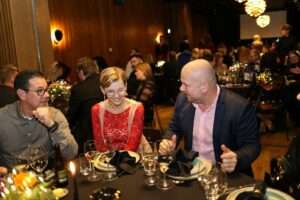
For a more upscale team building experience, a guided food and wine pairing dinner combines education, great food, and conversation in a format that naturally slows people down. Without phones in hand and with glasses in hand, people actually talk.
Best for: Smaller groups (10–20), senior leadership offsites, client entertainment that doubles as team bonding.
13. Paint and Sip
Low-pressure, accessible, and almost universally enjoyed. A skilled instructor walks your team through creating the same painting while wine flows. The results range from impressively good to impressively bad, and both outcomes generate equal amounts of laughter.
14. Axe Throwing
I was skeptical. Then I watched a group of finance analysts completely lose their minds in the best possible way at an axe throwing venue. Something about doing something slightly absurd and mildly dangerous (safely) together dissolves professional distance faster than almost anything else.
Best for: Teams who like a little edge. Not best for: very formal corporate cultures.
15. Behind-the-Scenes Industry Tour
A tour of a winery, brewery, distillery, or culinary production facility combines education and shared experience. People love seeing how things are made, and a guide with real expertise and personality can make an ordinary tour feel like a private masterclass.
How to Choose the Right Activity for Your Team
The best team building ideas for work are the ones that fit your team’s culture — not the ones that sound impressive on paper.
| Team Profile | Best Fit Ideas |
|---|---|
| Competitive, energetic | Blind tasting competition, escape room, game show |
| Creative, diverse | Pottery, cooking class, wine blending |
| Large group (50+) | Trivia, scavenger hunt, volunteering |
| Remote/distributed | Virtual blind tasting, virtual trivia |
| Senior leadership offsite | Wine pairing dinner, spirits tasting |
| Budget-conscious | Trivia night, scavenger hunt, Office Olympics |
Making It Stick
The experience itself is half the job. The other half is what happens before and after:
Before: Tell people what to expect. Uncertainty breeds dread. “We’re doing a blind wine tasting — no wine knowledge required, it’s beginner-friendly and competitive” is all you need.
After: Take photos. Send a follow-up with the highlights. Reference it in your next all-hands. The memory compounds when you keep returning to it.
A Note on Inclusive Team Building
The best team building ideas for work don’t require everyone to drink alcohol, perform physically, or spend money out of pocket. If you’re planning an experience that involves alcohol, always offer a non-alcoholic parallel. If you’re doing something physical, have a non-physical alternative role. No one should feel excluded from a team event.
If you’re looking for a guided experience, explore our wine tasting team building events and wine brand activation ideas — both designed to be accessible and genuinely fun for groups of all sizes.
Further Reading
For more on what makes team building effective: Harvard Business Review on Managing Teams and SHRM on Employee Engagement.