
Why Greek Wine Deserves Your Attention
Greek wine has been making and breaking empires for over 4,000 years. And yet, for most of recent wine history, Greece has been an afterthought on the world stage — a place known for retsina and not much else. That’s changing fast.
I’ve been recommending Greek wine to clients at corporate tastings for years now, and the reaction is almost always the same: genuine surprise followed by immediate curiosity. These wines taste like nothing else on Earth. The grape varieties are unique, the terroir is dramatic, and the value is exceptional compared to similarly positioned French or Italian wines.
If you haven’t explored Greek wine yet, this guide will change that. If you have, this will deepen your appreciation for what’s arguably the most underrated wine country in the world.
A Brief History of Greek Wine
Wine’s history in Greece goes back to at least 2000 BCE in the Bronze Age Aegean. The Greeks spread viticulture across Europe as they colonized — southern Italy, southern France, Spain — so in a very real sense, every European wine tradition has Greek DNA.
Ancient Greek wine was very different from what we drink today. It was often sweetened with honey, flavored with pine resin (the origin of retsina), seawater, or herbs, and diluted with water before drinking. Drinking undiluted wine was considered barbaric.
Modern Greek wine bears little resemblance to antiquity. The 20th century was rough — the 1950s–1980s saw bulk production dominate, quality collapsed, and Greece’s reputation suffered. But since the 1980s and especially the 1990s, a new generation of winemakers — many trained in France and Italy — have completely transformed the country’s wine identity.
Today, Greek wine is experiencing a genuine renaissance, with indigenous varieties that can’t be found anywhere else in the world.
Key Greek Wine Regions
Santorini
Santorini is where Greek wine’s global story really begins. The island sits in the southern Aegean, blasted by volcanic soil and Meltemi winds, and produces some of the most distinctive white wines on the planet.
The star grape is Assyrtiko, grown in basket-trained vines (kouloura) that literally curl on the ground to protect the grapes from the wind. Some of these vines are over 200 years old, surviving phylloxera because the volcanic soil is inhospitable to the louse.
Santorini white wines — almost always Assyrtiko-dominant — are electric with acidity, intensely mineral, and can age for decades. The volcanic soil gives them an unmistakable saline, smoky quality. If you want to understand why terroir matters, Santorini Assyrtiko is one of the most compelling demonstrations in wine.
Naoussa and Northern Greece (Xinomavro country)
Naoussa is in Macedonia, northern Greece, and this is where Xinomavro reigns. I find it helpful to think of Xinomavro as the Nebbiolo of Greece — high tannins, high acidity, earthy, with complex tertiary notes of tomato, olive, and dried herbs. It’s demanding when young but magnificent with age.
Naoussa PDO requires 100% Xinomavro and produces some of Greece’s most serious red wines. Nearby, Amyndeon produces lighter, more elegant expressions at higher altitude, and Goumenissa blends Xinomavro with Negoska for a more accessible style.
This region is still flying under the radar compared to Santorini, which makes it a great hunting ground for value.
Nemea (Agiorgitiko)
Nemea in the Peloponnese is Greece’s most planted PDO and the heartland of Agiorgitiko (also called St. George). This grape is far more approachable than Xinomavro — rounder, softer tannins, with red cherry, plum, and warm spice.
Nemea produces everything from easy-drinking rosé to serious age-worthy reds from high-altitude vineyards like Asprokampos. The altitude matters enormously here — lower valley wines can be jammy and simple, while high-elevation Agiorgitiko develops real complexity and freshness.
Crete
Crete is Greece’s largest wine-producing island and has a viticultural identity all its own. The primary grape is Vidiano for whites (aromatic, textural, with tropical fruit notes) and Kotsifali and Mandilari for reds (blended into the Peza and Archanes appellations).
Cretan wine has improved dramatically in quality over the past decade, and the island’s warm climate with significant maritime influence produces ripe, generous wines that over-deliver at every price point.
Other Notable Regions
- Macedonia’s Drama region: Produces excellent international varieties alongside indigenous grapes
- Epanomi: A small appellation near Thessaloniki famous for Gerovassiliou’s flagship Malagousia
- Patras: White wines from Roditis and the famous Mavrodaphne dessert wine
- Thessaly: Rapsani PDO, where Xinomavro blends with Krassato and Stavroto on the slopes of Mount Olympus
Essential Greek Wine Grape Varieties
White Varieties
Assyrtiko — The undisputed flagship. Grown primarily on Santorini but increasingly across Greece. High acid, mineral, citrus-driven, with extraordinary aging potential. The benchmark expression of Greek white wine.
Malagousia — An aromatic white rediscovered from near extinction in the 1990s by visionary producer Gerovassiliou. Intensely perfumed with white flowers, peach, and citrus. Very different from Assyrtiko — hedonistic and approachable.
Moschofilero — A pink-skinned grape from the Mantinia plateau that produces dry, aromatic whites with rose petal, citrus, and a delicate effervescence. Often compared to Pinot Grigio but more expressive.
Robola — The signature grape of Kefalonia island. Crisp, mineral, with a distinctive resinous note. Produces elegant, medium-bodied whites.
Vidiano — Crete’s most celebrated indigenous white. Fuller in body than Assyrtiko, with tropical fruit and a creamy texture when barrel-fermented.
Red Varieties
Xinomavro — Greece’s greatest red grape. “Xinomavro” literally means “sour black” — a nod to its high acid and deep color. Complex, tannic, ageable, with an olive-herbal character that sets it apart from any other grape.
Agiorgitiko — The other great Greek red. More fruit-forward and accessible than Xinomavro, with red cherry, plum, and spice. Greece’s most widely planted quality red variety.
Mavrodaphne — Grown around Patras and Kefalonia, primarily for the sweet fortified wine Mavrodaphne of Patras. Rich, raisiny, with walnut and dried fruit.
Liatiko — An ancient Cretan red that produces both dry wines and sweet Dafnes PDO dessert wine.
Greek Wine vs. Other Mediterranean Wines
| Feature | Greek Wine | Italian Wine | Spanish Wine |
|---|---|---|---|
| Indigenous varieties | 300+ native grapes | ~350 native grapes | ~400 native grapes |
| Flagship white grape | Assyrtiko | Pinot Grigio / Vermentino | Albariño / Verdejo |
| Flagship red grape | Xinomavro | Sangiovese / Nebbiolo | Tempranillo / Garnacha |
| Style profile | High acid, mineral | Diverse | Ripe, oak-influenced |
| Value | Excellent | Moderate | Good |
| International recognition | Growing | Established | Established |
| Primary food pairings | Seafood, lamb, mezze | Pasta, pizza, cured meats | Tapas, pork, seafood |
How to Read a Greek Wine Label
Greek wine labels can be intimidating at first — the Greek alphabet doesn’t help. A few things to look for:
PDO (Protected Designation of Origin): The top tier of Greek wine quality, equivalent to France’s AOC or Italy’s DOC. Wines labeled PDO Santorini, PDO Naoussa, PDO Nemea, etc. are regulated by strict rules.
PGI (Protected Geographical Indication): A broader category that allows more flexibility with grape varieties and blending. Many of Greece’s most innovative wines are PGI because winemakers want the freedom to experiment.
Vintage year: Important, especially for age-worthy wines like Naoussa Xinomavro. Older vintages of top producers can be extraordinary value.
Producer name: The Greek wine market is fragmented — knowing the top producers matters more here than in some other countries. Look for: Domaine Sigalas, Hatzidakis (Santorini); Kir-Yianni, Thymiopoulos (Xinomavro); Skouras, Gaia Wines (Nemea).
Food Pairing with Greek Wine
Greek wine was made to drink with food — the cuisine and the wine co-evolved over thousands of years. In my experience, the pairings are among the most natural and satisfying in the wine world.
Assyrtiko pairs brilliantly with grilled seafood, octopus, feta and olive oil, hummus and mezze, and anything with lemon. The acidity cuts through richness and the minerality mirrors the sea.
Xinomavro is made for lamb — roasted leg, slow-cooked kleftiko, grilled chops. The high tannins and acidity balance the richness of the meat perfectly. Also excellent with hard aged cheeses and mushroom dishes.
Agiorgitiko is versatile enough for a wide range: grilled meats, moussaka, pasta with tomato sauce, and even medium-weight cheese plates.
Malagousia works with aromatic, spiced dishes — Middle Eastern flavors, Thai cuisine, or simply as an aperitif with charcuterie.
Greek Wine for Corporate Wine Tastings
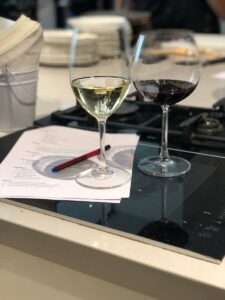
Greek wine is one of my favorite categories to feature in team wine tasting events. The reasons are practical and educational: the wines are genuinely surprising to most participants, the stories behind them are compelling (3,000 years of history, near-extinct grapes saved by individual winemakers), and the price-to-quality ratio makes it possible to show impressive bottles without blowing the budget.
I typically structure a Greek tasting around contrast: starting with a Santorini Assyrtiko to show the mineral, high-acid style, then moving to a Malagousia to show the aromatic, fruit-forward alternative, before finishing with a Xinomavro to demonstrate that Greece makes serious, age-worthy reds too.
If you’re interested in building a custom Greek wine experience for your team — whether it’s a tasting, a paired dinner, or a competitive blind tasting format — Myrna and the team at The Wine Voyage design experiences that go deep on regions like these. The discovery factor with Greek wine is unmatched.
Top Producers to Know
Domaine Sigalas (Santorini) — One of Santorini’s most celebrated estates. The Kavalieros single-vineyard Assyrtiko is a benchmark wine.
Hatzidakis Winery (Santorini) — Biodynamic farming on ancient vines. Their wines have extraordinary concentration and longevity.
Thymiopoulos Vineyards (Naoussa) — Young, dynamic producer bringing Xinomavro to a new audience. Accessible prices, exceptional quality.
Kir-Yianni (Naoussa) — Founded by Yiannis Boutaris, one of the fathers of modern Greek wine. Their Ramnista is a must-try.
Gaia Wines (Nemea and Santorini) — Innovative producer excelling in both regions. Try their Thalassitis Assyrtiko and Agiorgitiko By Gaia.
Gerovassiliou (Epanomi) — The man who saved Malagousia from extinction. His estate is the benchmark for this variety.
Skouras (Nemea) — Excellent Agiorgitiko across all price points, with particularly impressive single-vineyard wines.
Getting Started: Bottles to Try
If you’re new to Greek wine, here’s a progression that makes sense:
- Start with Assyrtiko — A Santorini PDO from Sigalas or Hatzidakis. Around $25–35. It’ll recalibrate what you think a white wine can be.
- Explore Agiorgitiko — Gaia Wines’ Agiorgitiko By Gaia is around $15 and superb introduction. Move up to their single vineyard if you love it.
- Tackle Xinomavro — Thymiopoulos “Jeunes Vignes” Xinomavro is around $20, a relatively accessible entry point to this serious grape.
- Try Malagousia — Gerovassiliou’s Malagousia is around $20 and will be unlike anything else in your glass.
For more wine exploration, read our guides on Viognier and Gewürztraminer for other aromatic whites, or dive into Nebbiolo to understand how Greek Xinomavro compares to Italy’s great tannic red. The wine regions guide also provides broader context for where Greece fits in the global wine map.
Further Reading
For deeper exploration of Greek wine, I recommend Wine Folly’s Greek Wine guide for excellent visual maps and variety breakdowns, and Decanter’s Greek wine resources for expert producer profiles and vintage notes.