Cava is one of the best values in the wine world, and most people still treat it as a budget Champagne substitute rather than what it actually is: a distinct, food-friendly sparkling wine with its own grapes, its own flavor profile, and its own identity worth understanding on its terms.
I’ve poured Cava at events where people assumed they were drinking something French and were surprised to hear it was Spanish. That’s not because Cava is an imitation — it’s because Cava made by the traditional method is genuinely excellent. The confusion says more about how underestimated Spain’s sparkling wine tradition has been than about any lack of quality.
This guide covers everything you need to know: the grapes, the production process, the quality tiers, how Cava compares to Champagne and Prosecco, and how to use it well at the table.
What Is Cava?
Cava is a Spanish sparkling wine produced by the método tradicional (traditional method) — the same labor-intensive process used in Champagne. Grapes are harvested, a still base wine is made, and then the wine undergoes a second fermentation in the same bottle it will eventually be sold in. This traps carbon dioxide naturally, creating fine, persistent bubbles and building complexity.
The vast majority of Cava is produced in Catalonia, specifically in the Penedès region centered on the town of Sant Sadurní d’Anoia, about 40 kilometers southwest of Barcelona. A handful of other Spanish regions are also authorized to produce Cava under the DO regulations.
Cava received its Denominación de Origen (DO) status in 1986 and has evolved steadily since — with newer quality tiers, stricter aging requirements, and a push toward single-estate and terroir-focused production that is reshaping what the category can achieve.
Cava Grapes
This is where Cava diverges most clearly from Champagne. The classic Cava grapes are indigenous Spanish varieties:
Macabeo (also called Viura) — The most widely planted of the three, providing freshness, acidity, and floral aromatics. It’s the backbone of most non-vintage Cava.
Parellada — Grown at higher altitudes in Penedès, Parellada brings elegance, citrus notes, and delicacy to blends. It’s aromatic and lowers the overall alcohol slightly.
Xarel·lo — The character grape of Cava. Xarel·lo adds body, texture, herbal notes, and a distinctive earthiness. It’s increasingly being bottled as a single-varietal by producers who want to showcase its complexity and aging potential.
These three are often used in combination, though Macabeo and Xarel·lo are increasingly dominant in quality-focused production.
Chardonnay and Pinot Noir are also permitted in Cava and appear frequently in the premium tiers (Reserva and Gran Reserva). Their inclusion brings international recognition and can add richness and red fruit character respectively.
Garnacha, Monastrell, and Trepat are the grapes for Cava Rosado (rosé Cava), producing everything from pale salmon to deep pink with strawberry and raspberry character.
How Cava Is Made
The traditional method is identical in principle to Champagne’s méthode champenoise:
- Harvest and base wine production — Grapes are harvested (typically in September for Penedès), pressed, and fermented into a still wine.
- Blending (assemblage) — Winemakers blend different varieties, vineyards, and often reserve wines from previous years to build a consistent house style or a specific character.
- Tirage — A mixture of wine, sugar, and yeast (liqueur de tirage) is added to each bottle, which is then sealed with a crown cap.
- Second fermentation — Bottles are stacked horizontally and the added sugar ferments slowly, building CO2 (bubbles) and adding complexity over weeks to months.
- Aging on lees — The wine rests in contact with yeast cells (lees) that slowly break down (autolysis), contributing biscuit, bread, and toasty flavors. This is what distinguishes traditional-method sparkling wine from tank-method wines like Prosecco.
- Riddling (remuage) — Bottles are gradually rotated to collect yeast sediment in the neck. Large producers use automated gyropalettes; traditional producers do it by hand.
- Disgorgement (dégorgement) — The neck is frozen and the yeast plug is ejected.
- Dosage — A small amount of wine and sugar (liqueur d’expédition) is added to adjust the final sweetness level, then the bottle is corked.
Cava Quality Tiers
The DO Cava has reorganized its classification in recent years to better communicate quality:
| Tier | Minimum Aging | Notes |
|---|---|---|
| Cava (non-vintage) | 9 months on lees | Entry level, reliable everyday quality |
| Cava Reserva | 15 months on lees | Step up in complexity, often excellent value |
| Cava Gran Reserva | 30 months on lees | Top tier, richer autolytic character |
| Cava de Paraje Calificado | 36 months, single vineyard | Highest tier, estate-specific quality |
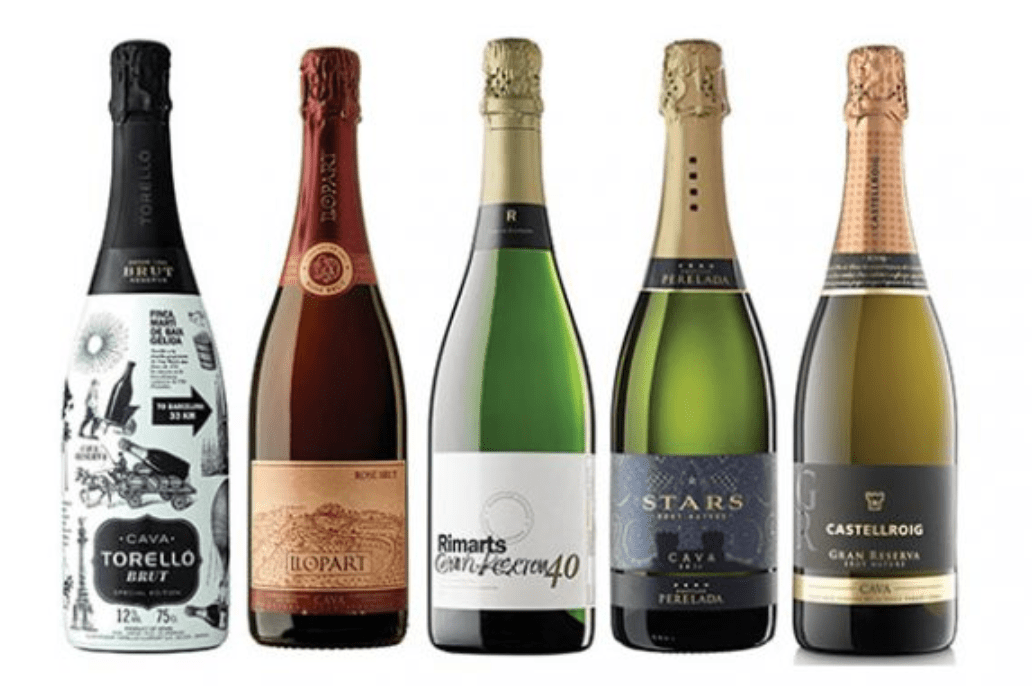
The Cava de Paraje Calificado designation was introduced to create a prestige category comparable to single-vineyard Champagne. Producers like Recaredo, Gramona, and Torelló are producing stunning wines at this level that deserve comparison with grower Champagnes at twice the price.
Sweetness Levels
Like Champagne, Cava uses a traditional sweetness classification:
| Term | Residual Sugar | Taste |
|---|---|---|
| Brut Nature | 0–3 g/L | Bone dry |
| Extra Brut | 0–6 g/L | Very dry |
| Brut | 0–12 g/L | Dry (most common) |
| Extra Seco | 12–17 g/L | Slightly off-dry |
| Seco | 17–32 g/L | Off-dry to slightly sweet |
| Semi-Seco | 32–50 g/L | Noticeably sweet |
| Dulce | 50+ g/L | Sweet |
For food pairing and most occasions, Brut or Brut Nature are the right calls. Extra Brut and Brut Nature are particularly fashionable in quality-focused Cava and suit a wide range of foods.
Cava vs. Champagne vs. Prosecco
These three dominate the sparkling wine market, and the differences matter.
| Feature | Cava | Champagne | Prosecco |
|---|---|---|---|
| Country | Spain | France | Italy |
| Production | Traditional method | Traditional method | Tank method (Charmat) |
| Key Grapes | Macabeo, Xarel·lo, Parellada | Chardonnay, Pinot Noir, Meunier | Glera |
| Bubbles | Fine and persistent | Fine and persistent | Softer, less persistent |
| Flavor Profile | Citrus, herbal, brioche | Toast, citrus, brioche | Peach, apple, floral |
| Aging Potential | Yes (Gran Reserva, Paraje) | Yes | Drink young |
| Typical Price | $12–$60 | $40–$300+ | $12–$25 |
Cava and Champagne share the same production method and both develop autolytic (yeast-derived) complexity from lees aging. The grapes are different, and the terroir (chalky soils of Champagne vs. the limestone and clay of Penedès) creates different flavor profiles. Cava tends to have a more savory, herbal character; Champagne leans more toward brioche and citrus.
Prosecco is made by the Charmat method (second fermentation in a tank, not the bottle), which produces a simpler, more immediately fruity style. Both Prosecco and Cava are excellent in their respective contexts. Prosecco for aperitivo and casual drinking; Cava for versatile food pairing and the occasions where you want autolytic complexity without the Champagne price tag.
How to Serve Cava
Temperature — Serve Cava cold but not frozen: 45–48°F is ideal. This preserves freshness and aromatics without numbing them.
Glassware — A tulip-shaped flute or an all-purpose white wine glass both work well. The bowl shape of a white wine glass opens up the aromatics more than a tall, narrow flute. Skip the flat coupe (it’s stylish but loses bubbles quickly).
Opening — Hold the cork firmly and rotate the bottle (not the cork) slowly. Aim for a soft sigh, not a pop. The dramatic pop wastes wine and gas.
Don’t keep it too long — Non-vintage Cava is made for freshness. Drink it within 1–3 years of release. Gran Reserva and Paraje wines age beautifully for 5–10+ years, but entry-level Cava isn’t built for the cellar.
Pairing Cava with Food
Cava is one of the most food-friendly sparkling wines because the acidity cuts through fat and the savory character from the indigenous grapes suits savory dishes.
Tapas and charcuterie — The classic pairing. Cava with Jamón ibérico, chorizo, manchego, and olives is a combination that makes sense from the inside out. The acidity, saltiness, and herbal edge align perfectly.
Seafood and shellfish — Brut Cava with grilled prawns, oysters, or salt cod is excellent. The wine’s salinity and citrus notes echo and amplify the flavors of the sea.
Fried foods — Anything fried benefits from a sparkling wine. Fried chicken with a glass of cold Cava is a pairing I will defend vigorously. The carbonation and acidity cut through the fat; the crunch and the bubbles harmonize.
Risotto and creamy pasta — A Gran Reserva Cava with a mushroom risotto is one of the great underrated pairings. The depth of autolytic character in the wine matches the umami richness of the dish.
Aged hard cheeses — Manchego, Comté, aged Gouda — all work well with a richer Cava. The contrast between the wine’s acidity and the cheese’s fat and salt is satisfying and well-balanced.
Light desserts — Semi-Seco or Seco Cava with fruit tarts, almond pastries, or crème caramel creates a pleasant match. Don’t pair Brut Cava with sweet desserts — it will taste harsh.
Producers Worth Knowing
The quality range in Cava is enormous — from industrial, neutral wine to serious, age-worthy estate bottles. Some producers consistently making wines worth seeking out:
Gramona — One of the most serious estates in Cava. Their Cellar Batlle and III Lustros Gran Reserva show what the category can genuinely achieve.
Recaredo — Family estate in Corpinnat (a group of traditional producers who left the DO to pursue stricter standards). Organic, long-aged, brut nature — among the finest sparkling wines made anywhere.
Juvé & Camps — Reliable quality at multiple price points. Their Reserva de la Familia is one of the best Cava values available.
Codorníu — The historic producer (founded 1551) whose Blanc de Blancs and Anna de Codorníu offer consistent quality at entry price points.
Raventós i Blanc — Also in Corpinnat, producing precise, mineral Cava from estate vineyards.
For everyday occasions, brands like Freixenet, Roger Goulart, and Segura Viudas offer reliable Brut Cava in the $12–$18 range that punches above its weight.
Cava in Corporate Events
At The Wine Voyage, Myrna Elguezabal frequently uses Cava as both an arrival pour and a teaching tool in corporate tasting events. A side-by-side of a quality Cava Reserva versus a non-vintage Champagne at similar price points is one of the most effective exercises in any tasting — it demonstrates the importance of production method, terroir, and the power of fresh eyes (and taste buds) over brand recognition. Teams consistently discover that their preferences don’t always align with the label. It’s a memorable lesson.
The Bottom Line on Cava
Cava is not a budget alternative to Champagne. It’s a serious, food-friendly sparkling wine with its own identity, its own grapes, and a quality ceiling that has been rising steadily. Understanding what you’re tasting — the Xarel·lo earthiness, the Macabeo freshness, the autolytic depth from bottle aging — makes every glass more interesting.
At entry price points, Cava delivers some of the best value in all of wine. At the top of the category, Paraje wines and Corpinnat producers are making bottles that deserve far more international recognition than they currently receive.
For more on sparkling wine, explore our guides to Champagne, Prosecco, and sparkling wine broadly. For the full picture of Spanish wine, see our Tempranillo guide and Rioja wine guide.
Further Reading
To go deeper on Cava and Spanish wine, I recommend Decanter’s Cava region guide and Wine Folly’s sparkling wine comparison chart.