Why Wine and Cheese Pairing Works
Wine and cheese pairing is one of those combinations that feels almost inevitable — and there’s real science behind it. Both wine and cheese are the result of fermentation, which means they share complementary acids, fats, and flavor compounds that play off each other beautifully. Fat in cheese softens wine’s tannins. Acidity in wine cuts through cheese’s richness. Salt in aged cheese makes fruit in wine pop.
But here’s what I find most useful: wine and cheese pairing doesn’t require memorization. Once you understand a few core principles, you can improvise with confidence at the cheese counter or at the table.
The biggest mistake people make is pairing big, tannic red wines with creamy, delicate cheeses. The tannin overwhelms the fat and you get a chalky, bitter finish. Instead, think about balance: light cheese with lighter wine, strong cheese with bolder wine — with a few brilliant exceptions along the way.
The Core Rules of Wine and Cheese Pairing
Match Intensity
The guiding principle: match the intensity of the wine to the intensity of the cheese. A delicate fresh chèvre would be crushed by a full-bodied Cabernet Sauvignon, but it sings alongside a crisp Sauvignon Blanc. A pungent aged Époisses can hold its own against a rich Sauternes.
When in doubt, ask: how strong is the cheese’s flavor? Then find a wine of similar weight.
Regional Pairing as a Shortcut
One of the easiest wine and cheese pairing strategies is to go regional. Wines and cheeses from the same region tend to grow up together — literally — and pair naturally. The slight bitterness of Pecorino cheese works with Sangiovese from Tuscany. Alsatian Munster is famously good with Alsatian Gewürztraminer. Loire Valley Sancerre (Sauvignon Blanc) is the classic match for Loire Valley Chèvre.
This isn’t a rule, but it’s a remarkably reliable starting point.
Acidity Is Your Best Friend
High-acid wines are almost universally good with cheese. The acid acts as a palate cleanser, cutting through the fat and resetting your mouth for the next bite. This is why Champagne, Riesling, Sauvignon Blanc, and Barbera d’Asti work so well across a broad range of cheeses.
Tannins Are Tricky
Red wines with high tannins — Cabernet Sauvignon, young Barolo, Nebbiolo — can clash with creamy, fatty cheeses. The tannin binds to the fat and creates a metallic, astringent sensation. If you love big reds with cheese, reach for aged hard cheeses (aged Cheddar, Parmigiano-Reggiano, Manchego) where the fat has crystallized and the texture is firm enough to handle tannin.
Best Wine and Cheese Pairings by Cheese Type
Fresh Cheeses: Chèvre, Ricotta, Burrata, Cream Cheese
Fresh cheeses are mild, creamy, and high in moisture. They need wines with bright acidity that won’t overpower their delicacy.
Best pairings:
- Sauvignon Blanc (especially Loire Valley — the classic match for chèvre)
- Dry Rosé
- Grüner Veltliner
- Prosecco or Cava
- Pinot Grigio
Avoid: heavy reds, high-tannin wines
Soft-Ripened Cheeses: Brie, Camembert, Époisses
These have a bloomy rind and a buttery, mushroomy interior. They range from mild (young Brie) to assertive (fully ripe Camembert or washed-rind Époisses). Wine and cheese pairing here works best when you match the intensity of the specific cheese.
Best pairings:
- Champagne (the classic Brie pairing — bubbles and acidity cut through the fat beautifully)
- White Burgundy (Chardonnay) — for richer, more developed Brie
- Pinot Noir — the earthy, red-fruit character complements the mushroomy rind
- Sauternes with Époisses — the sweet-savory contrast is extraordinary
Avoid: tannic red Bordeaux blends
Blue Cheeses: Roquefort, Gorgonzola, Stilton, Cambozola
Blue cheese is one of the most powerful cheeses at the table — salty, pungent, with a creamy but sharp bite. Successful wine and cheese pairing here often involves sweet wines, where the sugar-salt contrast creates something magic.
Best pairings:
- Sauternes with Roquefort — this is one of the greatest wine and cheese pairing combinations in existence
- Port wine (Tawny or Vintage) with Stilton — the British classic
- Moscato d’Asti — lighter and slightly sweet, works with milder blues like Gorgonzola Dolce
- Amarone or bold Zinfandel — if you want a dry pairing, you need big fruit to balance the salt and funk
Avoid: light, delicate whites — they’ll be steamrolled
Semi-Hard Cheeses: Gruyère, Comté, Fontina, Manchego, Gouda
This is arguably the most versatile category for wine and cheese pairing. Semi-hard cheeses have enough texture and flavor to pair with a wide range of wines — whites, light reds, rosés.
Best pairings:
- White Burgundy or Chardonnay — the nutty, creamy character of Gruyère and Comté mirrors oaked Chardonnay
- Rioja (Tempranillo) — the earthy spice of aged Rioja is a natural match for Manchego
- Pinot Noir — works beautifully with Fontina and Comté
- Rhône whites (Viognier, Roussanne) — excellent with Gruyère
Hard Aged Cheeses: Parmigiano-Reggiano, Aged Cheddar, Pecorino, Aged Manchego
Hard, aged cheeses have complex flavors — salty, nutty, sometimes caramel-like — and a crystalline texture. The reduced moisture and fat means they can handle tannins that would overwhelm younger cheeses.
Best pairings:
- Barolo or Barbaresco with Parmigiano-Reggiano — a Piedmont love story
- Aged Cabernet Sauvignon — now the tannins work in your favor
- Chianti Classico with Pecorino — the Tuscany regional pairing principle at work
- Tawny Port with aged Gouda — the nutty, caramel notes in both are extraordinary together
- Rioja Reserva or Gran Reserva — the leather and spice complexity pairs beautifully with aged hard cheeses
Wine and Cheese Pairing Chart
| Cheese | Style | Best Wine Pairing | Why It Works |
|---|---|---|---|
| Fresh Chèvre | Fresh, tangy | Sauvignon Blanc | Acidity echoes the cheese’s tang |
| Brie | Soft, buttery | Champagne | Bubbles + acidity cut the fat |
| Époisses | Washed-rind, pungent | Sauternes | Sweet contrast tames the funk |
| Roquefort | Blue, salty | Sauternes | Classic sweet-savory contrast |
| Stilton | Blue, complex | Vintage Port | The British icon pairing |
| Gruyère | Semi-hard, nutty | White Burgundy | Shared richness and nuttiness |
| Manchego | Semi-hard, tangy | Rioja | Regional Spanish pairing |
| Parmigiano-Reggiano | Hard, crystalline | Barolo | Piedmont regional classic |
| Aged Cheddar | Hard, sharp | Cabernet Sauvignon | Fat handles the tannins |
| Aged Gouda | Hard, caramel | Tawny Port | Nutty notes in both |
| Gorgonzola Dolce | Blue, creamy | Moscato d’Asti | Light sweetness matches mildness |
| Camembert | Soft, earthy | Pinot Noir | Earthiness echoes the rind |
Sweet Wines and Cheese: The Unexpected Hero
I think sweet wines are the most underrated pairing partner for cheese, and I encounter this misconception constantly when leading wine tastings. People assume you need dry wine with cheese. But some of the greatest wine and cheese pairing combinations in history are sweet + salty:
- Sauternes + Roquefort: The honeyed, botrytized sweetness of Sauternes and the salty, funky punch of Roquefort is a revelation. Both are expensive, but even affordable Sauternes-style wines work well.
- Port + Stilton: A British tradition for good reason. Vintage Port is all dark fruit and chocolate; Stilton is all salt and blue funk. The contrast is stunning.
- Riesling Spätlese + Aged Gouda: The wine’s residual sweetness, bright acidity, and petrol-mineral notes against the caramel nuttiness of aged Gouda is one of my favorite pairings.
The principle: salt in cheese amplifies sweetness in wine, and sweetness softens salt. It’s a flavor see-saw that works almost every time.
How to Build a Wine and Cheese Board
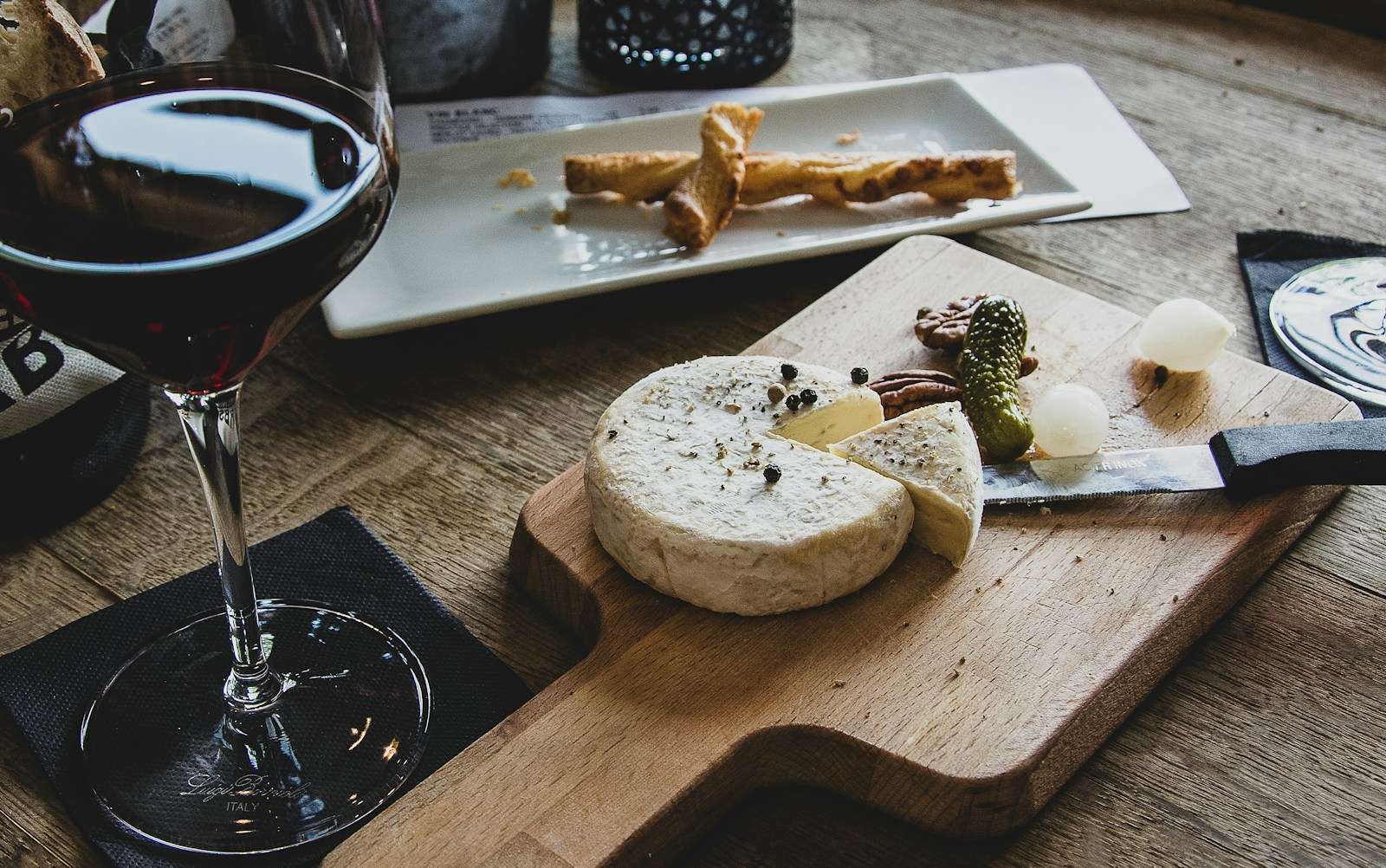
When assembling a board for a group, cover different cheese styles so guests can experience multiple wine and cheese pairing combinations.
A well-rounded board includes:
- 1 fresh cheese (chèvre, burrata, or ricotta)
- 1 soft-ripened cheese (Brie or Camembert)
- 1 semi-hard cheese (Comté, Gruyère, or Manchego)
- 1 aged hard cheese (Parmigiano, aged Cheddar, or aged Gouda)
- 1 blue (Gorgonzola Dolce or Roquefort)
Wine to serve with a mixed board: If you’re serving one wine for a full cheese board, choose a high-acid, medium-bodied option that bridges multiple styles. Champagne, dry Riesling, and Pinot Noir are all versatile enough to work across fresh, semi-hard, and mild aged cheeses. For a two-wine board, pair one white and one red — or one dry and one sweet.
Practical Tips for Wine and Cheese Pairing Events
Cheese boards have become a staple of corporate entertaining — and for good reason. They’re approachable, visually impressive, and create natural conversation. A few practical notes from experience running group wine and cheese events:
Temperature matters: Serve cheese at room temperature. Cold cheese mutes flavor and makes wine and cheese pairing harder to appreciate. Pull the cheese from the fridge 30–45 minutes before serving.
Taste progression: Move from light to strong — fresh cheeses first, blues last. Same with wine: lighter whites before fuller reds or sweet wines.
Quantity per person: For a standalone cheese course, plan 2–3 oz of each cheese per person. For a cocktail-style tasting, plan 1–1.5 oz per style.
Palate cleansers: Plain crackers, sliced baguette, and plain water help reset between combinations. Grapes and honey on the board also act as palate cleansers and add natural sweetness that bridges wine and cheese.
Corporate wine and cheese tasting events work well for team building precisely because there’s no wrong answer — it’s experiential and exploratory. At The Wine Voyage, Myrna Elguezabal has built team-building experiences around exactly this kind of interactive pairing exploration, where participants form their own opinions rather than being lectured at. It turns a meal into a shared conversation.
Common Wine and Cheese Pairing Mistakes
Tannic reds with creamy cheese. Young Cabernet Sauvignon or Shiraz with fresh Brie creates a chalky, bitter finish. Save the big reds for aged hard cheeses.
Pairing everything with Champagne. Champagne is versatile, but it doesn’t work well with very pungent washed-rind cheeses or very strong blues — the delicacy gets overwhelmed.
Ignoring regional pairings. When in doubt, go regional. The wine and cheese from the same area almost always work.
Forgetting sweet wine. Dessert wines are not just for dessert. They’re often the best pairing for cheese, especially blues and aged styles.
Pairing wine before you taste the cheese. Take a bite of cheese first, let it coat your palate, then sip the wine. The sequence matters.
For more foundational knowledge that enhances your wine and cheese pairing, explore our guides on how to taste wine, wine regions, Champagne, Port wine, Sauternes and sweet wines, and Sangiovese. If you’re exploring specific wines that shine at the cheese table, our Chardonnay guide, Pinot Noir guide, and Riesling guide are great starting points.
Further Reading
To deepen your wine and cheese pairing knowledge, these authoritative resources are worth bookmarking: Wine Folly’s visual cheese and wine pairing guide and Decanter’s comprehensive cheese and wine pairing feature.